
"SYMBOLES (Gleichnisse »)" – 77 rezultate
0.01 secundeMeilisearch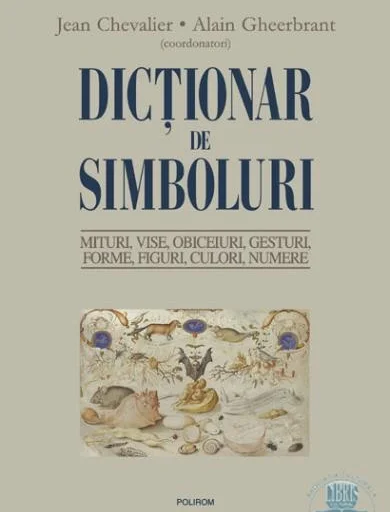 JC
JCJean Chevalier
Jean Chevalier (1906-1993) was a university lecturer in philosophy and theology before working for UNESCO, where he was Director of Relations for Member States. He left in 1964 to devote himself to writing and research. He published many works on topics such as St Augustine, Descartes, African religion, Sufism, human spirituality and transcendental meditation. Jean Chevalier is the author of The Penguin Dictionary of Symbols (Dictionary, Penguin), and has 7 books that have been rated 70 times on Goodreads. Intr-o epoca in care imaginatia este revalorificata ca resort al descoperirilor si progresului, dictionarul coordonat de Jean Chevalier si Alain Gheerbrant ilustreaza varietatea cheilor de interpretare – oficiale si subversive, analitice si emotionale, spirituale si sexuale – oferite in diferite culturi simbolurilor fundamentale ale omenirii. Cu informatii din cele mai diverse domenii, de la teologie si astrologie la psihanaliza sau publicitate, si avind la baza surse folclorice,...
2 poezii, 0 proze
 CM
CMCalbău Roxana Mirabela
Roxana Mirabela Calbău
9 poezii, 0 proze
 AB
ABAloysius Bertrand
Louis-Jacques-Napoléon “Aloysius” Bertrand (20 April 1807 – 29 April 1841) was a French poet instrumental in the introduction of the prose poem into French literature and is credited with inspiring later Symbolist poets [1]. He wrote a collection of poems entitled Gaspard de la nuit, after which composer Maurice Ravel wrote a suite of the same name, based on the poems "Scarbo", "Ondine", and "Le Gibet". Bertrand was born in Ceva, Piedmont, Italy (then a part of Napoleonic France) and his family settled in Dijon in 1814. There he developed an interest in the Burgundian capital. His contributions to a local paper lead to recognition by Victor Hugo and Sainte-Beuve. He lived in Paris shortly with little success. He returned to Dijon and continued writing for local newspapers. Gaspard was sold in 1836 but it wasn't published until 1842 after his death of tuberculosis. The book was rediscovered by Charles Baudelaire and Stéphane Mallarmé. It is now considered a classic of poetic and...
8 poezii, 0 proze
 RV
RVRenée Vivien
Renée Vivien, born Pauline Mary Tarn (11 June 1877 - 18 November 1909) was a British poet who wrote in the French language.[1][2] She took to heart all the mannerisms of Symbolism, as one of the last poets to claim allegiance to the school. Her compositions include sonnets, hendecasyllabic verse, and prose poetry. Vivien was born in London, England to a wealthy British father and an American mother from Jackson, Michigan. She grew up in Paris and London. Upon inheriting her father's fortune at 21, she emigrated permanently to France. In Paris, Vivien's dress and lifestyle were as notorious among the bohemian set as was her verse. She lived lavishly, as an open lesbian, and carried on a well-known affair with American heiress and writer Natalie Clifford Barney. She also harbored a lifelong obsession with her closest childhood friend and neighbor, Violet Shillito – a relationship that remained unconsummated. In 1900 Vivien abandoned this chaste love, when the great romance with Natalie...
17 poezii, 0 proze
 VL
VLVilliers de l'Isle-Adam
Jean-Marie-Mathias-Philippe-Auguste, comte de Villiers de l'Isle-Adam (7 November 1838 – 19 August 1889) was a French symbolist writer. Villiers de l'Isle-Adam was born in Saint-Brieuc, Brittany, to a distinguished aristocratic family. His parents, Marquis Joseph-Toussaint and Marie-Francoise (née Le Nepvou de Carfort) were not rich, however, and were financially supported by Marie's aunt, Mademoiselle de Kerinou. His father became obsessed with the idea he could restore the family fortune by finding the lost treasure of the Knights of Malta (Philippe Villiers de L'Isle-Adam, 16th century Grand Master of the Knights Hospitaller, was his ancestor), which had reputedly been buried near Quintin during the French Revolution. Consequently, he spent large sums of money buying land, excavating it and then selling it at a loss when he failed to find anything of value. The young Villiers' education was troubled (he attended over half a dozen different schools) but from an early age his family...
1 poezii, 0 proze
 SM
SMStéphane Mallarmé
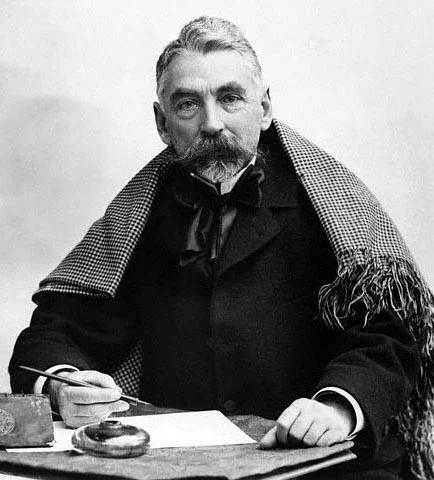
Stéphane Mallarmé (n. 18 martie, 1842, d. 9 septembrie, 1898), de fapt cu numele real Étienne Mallarmé, a fost un poet și critic francez. A cultivat o poezie cerebrală, voit obscură, bogată în sensuri filosofice, de o rară muzicalitate și forță sugestivă. Creația sa ("Herodiada", "După-amiaza unui faun", "Poezii") constituie o expresie viguroasă și originală a poeziei moderne. *** Stéphane Mallarmé (French pronunciation: [malaʁˈme]) (18 March 1842 – 9 September 1898), whose real name was Étienne Mallarmé, was a French poet and critic. He was a major French symbolist poet, and his work anticipated and inspired several revolutionary artistic schools of the early 20th century, such as Dadaism, Surrealism, and Futurism. Stéphane Mallarmé was born in Paris. He worked as an English teacher, and spent much of his life in relative poverty; but he was famed for his salons, occasional gatherings of intellectuals at his house on the rue de Rome for discussions of poetry, art,...
51 poezii, 0 proze
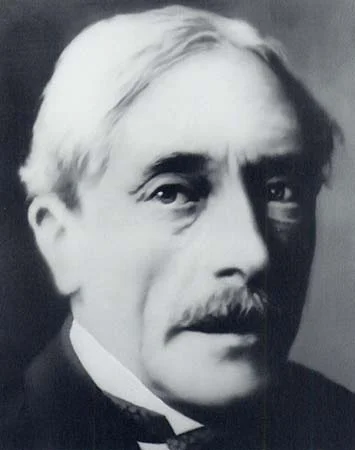 PV
PVPaul Valéry
Paul Valéry (1871-1945) - in full Ambroise-Paul-Touissaint-Jules Valéry French poet, essayist, and critic, who ceased writing verse for twenty years to pursue scientific experiments. Valéry was a member of the 19th-century poetic school of Symbolism, and its last great representative. Throughout his life Valéry filled his private notebooks with observations on creative process and his own methods of inquiry. He insisted that the mental process of creation was alone important - the poems were a by-product of the effort. "Enthusiasm is not an artist's state of mind", stated Valéry. T.S. Eliot has compared Valéry's analytical attitude to a scientist who works in a laboratory "weighing out or testing the drugs of which is compounded some medicine with an impressive name." "Poetry is simply literature reduced to the essence of its active principle. It is purged of idols of every kind, of realistic illusions, of any conceivable equivocation between the language of "truth" and the language...
15 poezii, 0 proze
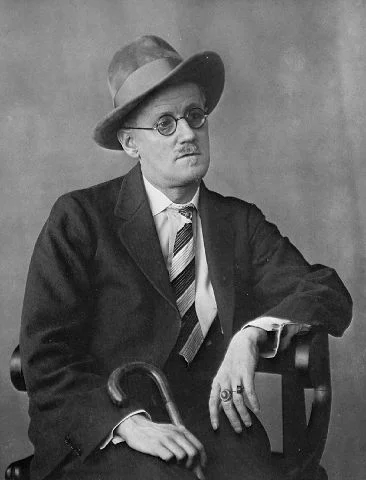 JJ
JJJames JOYCE
James Joyce (1882-1941), Irish novelist, noted for his experimental use of language in such works as Ulysses (1922) and Finneganns Wake (1939). Joyce\'s technical innovations in the art of the novel include an extensive use of interior monologue; he used a complex network of symbolic parallels drawn from the mythology, history, and literature, and created a unique language of invented words, puns, and allusions. James Joyce was born in Dublin, on February 2, 1882, as the son of John Stanislaus Joyce, an impoverished gentleman, who had failed in a distillery business and tried all kinds of professions, including politics and tax collecting. Joyce\'s mother, Mary Jane Murray, was ten years younger than her husband. She was an accomplished pianist, whose life was dominated by the Roman Catholic Church. In spite of their poverty, the family struggled to maintain a solid middle-class facade. From the age of six Joyce, was educated by Jesuits at Clongowes Wood College, at Clane, and then at...
17 poezii, 0 proze
 GS
GSGershom Scholem
Gershom Scholem (December 5, 1897 – February 21, 1982), also known as Gerhard Scholem, was a Jewish philosopher and historian raised in Germany. He is widely regarded as the founder of the modern, academic study of Kabbalah, becoming the first Professor of Jewish Mysticism at the Hebrew University of Jerusalem. Scholem is best known for his collection of lectures, Major Trends in Jewish Mysticism (1941) and for his biography Sabbatai Zevi, the Mystical Messiah (1973). His collected speeches and essays, published as On Kabbalah and its Symbolism (1965), helped to spread knowledge of Jewish mysticism among non-Jews. He was awarded the Israel Prize in 1958 and was elected president of the Israel Academy of Sciences and Humanities in 1968. Major Trends in Jewish Mysticism 1941 Jewish Gnosticism, Merkabah Mysticism, and the Talmudic Tradition 1960 Hannah Arendt and Gershom Scholem "Eichmann in Jerusalem: Exchange of Letters between Gershom Scholem and Hannah Arendt", in Encounter 22/1...
1 poezii, 0 proze
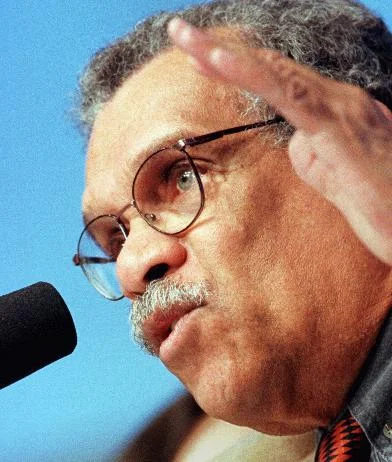 DW
DWDerek Walcott
Derek Alton Walcott (born January 23, 1930) is a Caribbean poet, playwright, writer and visual artist. Born in Castries, St. Lucia, he won the Nobel Prize for Literature in 1992. His work, which developed independently of the schools of magic realism emerging in both South America and Europe at around the time of his birth, is intensely related to the symbolism of myth and its relationship to culture. He is best known for his epic poem Omeros, a reworking of Homeric story and tradition into a journey around the Caribbean and beyond to the American West and London. Walcott founded the Trinidad Theatre Workshop in 1959, which has produced his plays (and others) since that time, and remains active with its Board of Directors. He also founded Boston Playwrights' Theatre at Boston University in 1981 with the hope of creating a home for new plays in Boston, Massachusetts. Walcott retired from teaching poetry and drama in the Creative Writing Department at Boston University in 2007. In fall...
17 poezii, 0 proze
\"unu\" noaptea
de Aurel Zaremba
Il est dans l\'essence des symboles d\'être symboliques. Jacques Vaché Sufletele îngemănate s-au lovit de instrumentele jazului și au țipat. Din tromba saxofonului a ieșit o capră c-un teanc de...
Ioana Iosa – «L’Architecture des régimes totalitaires face à la démocratisation»
de Marina Nicolaev
Ioana Iosa – "L'Architecture des régimes totalitaires face à la démocratisation" L'Harmattan, Paris ISBN : 978-2-296-05454-7 14,50 euro Volumul "L'’Architecture des régimes totalitaires face à la...
Sacrul si Profanul
de Mircea Eliade
Mircea ELIADE, SACRUL SI PROFANUL Humanitas, 1995 MIRCEA ELIADE (Bucuresti, 28 februarie 1907 — Chicago, 22 Aprilie 1986) a fåcut studii de filozofie la Bucuresti, încheiate cu o tezå...
Sacrul si profan
de Mircea Eliade
MIRCEA ELIADE (Bucure¿ti, 28 februarie 1907 — Chicago, 22 aprilie 1986) a fåcut studii de filozofie la Bucure¿ti, încheiate cu o tezå despre filozofia Rena¿terii (1928)...
Signs Symbols and Secrets: Decoding The DaVinci Code
de Carmen Harra
Signs, Symbols, and Secrets decodes in a fascinating new way the secrets behind The Da Vinci Code impact on the world. This book unlocks the hidden secrets of the truth about Jesus\' life and death...
Amintiri, cu sirene din alte vieți...
de Iulia Elize
”Cubul cu miere de mare, briză care spune povești (The symbols) - Poem în proză, cu sirenele și cu marea care nu se duce în mare.. (Fragmente cu sirene) Fragment I. FRAGMENT CU MAREA CARE NU SE MAI...
What You Offered Me...
de Tia
Snow...white and pure Slowly falling toward the frozen earth... I stare out the window carefully watching its every move... Lost in my thoughts...of me...of you, The distance and time between us. The...
Mircea Eliade (1)
de Mircea Eliade
Eliade, Mircea (1907-1986, n. București), filosof și scriitor român. Studii la Universitatea din București și din Calcutta. Stabilit în S.U.A., profesor la Universitatea din Chicago....
Personajul dincolo de personaj în Mă numesc Roșu
de Ioana Petcu
Primul Premiu Nobel pentru Literatură pentru un scriitor turc Mai puțin cunoscut publicului român, Orhan Pamuk este un romancier cu numeroase merite în Turcia și cu o poziție destul de controversată....
De ziua ta...
de Calbău Roxana Mirabela
Azi din nou nu suntem împreună Mii de kilometri ne despart De câțiva ani, tot așa suntem Despărțiți... ca un fruct de un copac. Sunt vise, gânduri, lacrimi și dorințe De câțiva ani, toate-nghemuite...