
"Heeped" – 21 rezultate
0.00 secundeMeilisearch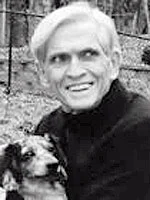 WD
WDWilliam Diehl
William Diehl (December 4, 1924 – November 24, 2006) was an American novelist and photojournalist. Diehl was fifty years old and already a successful photographer and journalist when he decided he had not heeded his life calling. The day after his 50th birthday he began his first novel, Sharky's Machine, which was made into a movie directed by and starring Burt Reynolds. Diehl later completed eight more novels, including Primal Fear, which became a movie by the same name starring Richard Gere and Edward Norton. Diehl died at Emory University Hospital in Atlanta, Georgia on November 24, 2006, of an aortic aneurism. He was a resident of Woodstock, Georgia at the time of his death and was working on his tenth novel. Bibliography Sharky's Machine (1978) Chameleon (1981) Hooligans (1984) Thai Horse (1987) 27 (1990) The Hunt [aka 27] (1990) Primal Fear (1992)† Show Of Evil (1995)† Reign in Hell (1997)† Eureka (2002)
3 poezii, 0 proze
 JH
JHJames Leigh Hunt
James Leigh Hunt was born on 19th October, 1784 in Southgate, Middlesex. His father, a clergyman, got into financial difficulties and ended up in a debtor's prison. As a young man, Hunt developed an interest in politics and poetry. Leigh Hunt became friends with other young writers who favoured political reform including Percy Bysshe Shelley, William Hazlitt, Henry Brougham, Lord Byron,Thomas Barnes and Charles Lamb. As well as writing poetry and articles on politics, Leigh Hunt worked as a drama critic for the News. In 1808 Leigh Hunt helped his brother, John Hunt, to start a political journal called the Examiner. The journal gave support to radicals in Parliament such as Henry Brougham and Sir Francis Burdett and the political ideas of people like Robert Owen and Jeremy Bentham. Leigh Hunt upset the authorities by pointing out on the front page of every edition of the Examiner that half the cost of the price was the result of the government's "tax on knowledge". In 1812 Leigh and...
1 poezii, 0 proze
 AH
AHAldous Leonard Huxley
[[en]] Aldous Leonard Huxley was born on July 26, 1894, into a family that included some of the most distinguished members of that part of the English ruling class made up of the intellectual elite. Aldous' father was the son of Thomas Henry Huxley, a great biologist who helped develop the theory of evolution. His mother was the sister of Mrs. Humphrey Ward, the novelist; the niece of Matthew Arnold, the poet; and the granddaughter of Thomas Arnold, a famous educator and the real-life headmaster of Rugby School who became a character in the novel Tom Brown's Schooldays.Brave New World book cover Undoubtedly, Huxley's heritage and upbringing had an effect on his work. Gerald Heard, a longtime friend, said that Huxley's ancestry "brought down on him a weight of intellectual authority and a momentum of moral obligations." Throughout Brave New World you can see evidence of an ambivalent attitude toward such authority assumed by a ruling class. Like the England of his day, Huxley's Utopia...
8 poezii, 0 proze
 YA
YAYosano Akiko
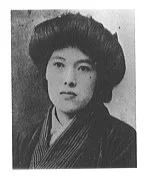
Akiko Yosano, 7 December 1878 - 29 May 1942) was the pen-name of a Japanese author, poet, pioneering feminist, pacifist, and social reformer, active in late Meiji period, Taishō period and early Showa period Japan. Her real name was Yosano Shiyo. She is one of the most famous, and most controversial, post-classical woman poets of Japan. Yosano was born the daughter of a rich merchant in Sakai, Osaka. From early childhood, she was fond of reading literary works while she helped her family business. When she was a high school student, she began to subscribe to the poetry magazine Myōjō (Bright Star), and she became one of its most important contributors. Myōjō’s editor, Yosano Tekkan, taught her tanka poetry and sometimes visited her in Sakai. Although Tekkan was married, the two authors fell in love and started a new life together in the suburb of Tokyo. Tekkan eventually divorced his wife and married Akiko in 1901. In 1901, Yosano brought out her first volume...
1 poezii, 0 proze
 GV
GVGilles Vigneault
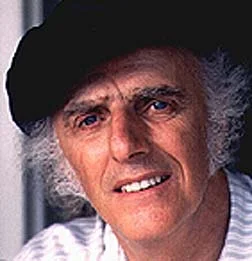
Gilles Vigneault, (born 27 October 1928) is a Québécois poet, publisher and singer-songwriter, and well-known Quebec nationalist and sovereigntist. A poet deeply rooted in his native Quebec, Vigneault has become an icon at home and Quebec ambassador abroad. He was one of the principal figures of the generation of chansonniers who helped the Quebec chanson find its own identity, even while helping it find a universal dimension. Born in Natashquan, on the far north shore of the St. Lawrence River in Quebec, he was educated in Rimouski and Quebec City. Vigneault started writing poetry during his studies at the Seminary in Rimouski, and by the 1950s was publishing poems and writing songs. In 1959 he founded a publishing house, Les Éditions de l'Arc to distribute his publications. His first collection, Étraves was published in 1959. In August 1960, at the request of the audience at the boîte à chansons L'Arlequin in Quebec City, he agreed to sing his earliest song: Jos Monferrand, written...
10 poezii, 0 proze
 GS
GSGershom Scholem
Gershom Scholem (December 5, 1897 – February 21, 1982), also known as Gerhard Scholem, was a Jewish philosopher and historian raised in Germany. He is widely regarded as the founder of the modern, academic study of Kabbalah, becoming the first Professor of Jewish Mysticism at the Hebrew University of Jerusalem. Scholem is best known for his collection of lectures, Major Trends in Jewish Mysticism (1941) and for his biography Sabbatai Zevi, the Mystical Messiah (1973). His collected speeches and essays, published as On Kabbalah and its Symbolism (1965), helped to spread knowledge of Jewish mysticism among non-Jews. He was awarded the Israel Prize in 1958 and was elected president of the Israel Academy of Sciences and Humanities in 1968. Major Trends in Jewish Mysticism 1941 Jewish Gnosticism, Merkabah Mysticism, and the Talmudic Tradition 1960 Hannah Arendt and Gershom Scholem "Eichmann in Jerusalem: Exchange of Letters between Gershom Scholem and Hannah Arendt", in Encounter 22/1...
1 poezii, 0 proze
John Keats
John Keats John Keats (October 31, 1795 – February 23, 1821) was one of the principal poets of the English Romantic movement. During his short life, his work received constant critical attacks from the periodicals of the day, though politics, rather than aesthetics, often dictated those opinions. By the mid-nineteenth century, however, audiences began to appreciate more fully the significance of the cultural change his work both presaged and helped to form. Elaborate word choice and sensual imagery characterize Keats' poetry. He often felt himself working in the shadow of past poets, particularly Milton and Spenser, and only towards the end of his life produced his most original and most memorable poems, including a series of odes that remain among the most popular poems in English. Oscar Wilde, the aestheticist non pareil was to later write: "[...] who but the supreme and perfect artist could have got from a mere colour a motive so full of marvel: and now I am half enamoured of the...
0 poezii, 0 proze
 DG
DGDavid Gascoyne
David Gascoyne (October 10, 1916 - November 25, 2001) was an English poet associated with the Surrealist movement. Gascoyne was born in Harrow and grew up in England and Scotland and attended Salisbury Cathedral School and Regent Street Polytechnic in London. He spent part of the early 1930s in Paris. His first book, Roman Balcony and Other Poems, was published in 1932, when he was sixteen. A novel, Opening Day, was published the following year. However, it was Man's Life is This Meat (1936), which collected his early surrealist work and translations of French surrealists, and Hölderlin's Madness (1938) that established his reputation. These publications, together with his 1935 A Short Survey of Surrealism and his work on the 1936 London International Surrealist Exhibition, which he helped to organise, made him one of a small group of English surrealists that included Hugh Sykes Davies and Roger Roughton. Ironically, at this exhibition, Gascoyne had to rescue Salvador Dalí from the...
5 poezii, 0 proze
William Carlos Williams
He was born in Rutherford, New Jersey, a town near the city of Paterson. He attended public school in Rutherford, New Jersey until 1897, then was sent to study at Château de Lancy near Geneva, Switzerland, the Lycée Condorcet in Paris, France, for two years and Horace Mann High School in New York City. Then, in 1902, he entered the University of Pennsylvania Medical School. During his time at Penn, Williams befriended Ezra Pound, Hilda Doolittle (H.D.) and the painter Charles Demuth. These friendships supported his growing passion for poetry. He received his M.D. in 1906 and spent the next four years in internships in New York City and in travel and postgraduate studies abroad (e.g., at the Univ. of Leipzig where he studied pediatrics). He returned to Rutherford in 1910 and began his medical practice, which lasted until 1951. In his life he helped to deliver more than two thousand babies but regarded his medical career as a way to finance his final goal of becoming a poet. In 1912 he...
0 poezii, 0 proze
 RB
RBRupert Chawner Brooke
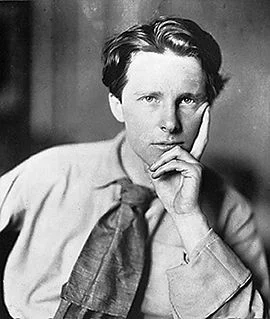
Rupert Chawner Brooke (middle name sometimes given as Chaucer)(3 August 1887–23 April 1915) was an English poet known for his idealistic war sonnets written during the First World War (especially The Soldier); however, he never experienced combat at first hand. He was also known for his boyish good looks, which prompted the Irish poet William Butler Yeats to describe him as \"the handsomest young man in England\". English poet Brooke was born at 5 Hillmorton Road in Rugby, Warwickshire, the second of the three sons of William Parker Brooke, a Rugby schoolmaster, and Ruth Mary Brooke, née Cotterill. He attended Hillbrow Prep School before being educated at Rugby School. While travelling in Europe, he prepared a thesis entitled \"John Webster and the Elizabethan Drama\", which won him a scholarship to King\'s College, Cambridge, where he became a member of the Cambridge Apostles, helped found the Marlowe Society drama club and acted in plays including the Cambridge Greek Play. Brooke...
7 poezii, 0 proze
The Plunge
de Ezra Pound
I would bathe myself in strangeness: These comforts heaped upon me, smother me! I burn, I scald so for the new, New friends, new faces, Places! Oh to be out of this, This that is all I wanted - save...
Crapulous Impression
de Aldous Leonard Huxley
(To J.S.) Still life, still life…the high-lights shine Hard and sharp on the bottles: the wine Stands firmly solid in the glasses, Smooth yellow ice, through which there passes The lamp\'s bright...
Darkness
de George Gordon Noel Byron
I had a dream, which was not all a dream. The bright sun was extinguished, and the stars Did wander darkling in the eternal space, Rayless, and pathless, and the icy earth Swung blind and blackening...
The Nightingale and the Rose
de Chiru Anda
And the walls were closing in, Taking me there, deep within, I was screaming “Help me now!” Hope You’ll be there By my side So You’ll take me Through the night! Save me now Take me there In your arms...
The Last Question
de Isaac Asimov
The last question was asked for the first time, half in jest, on May 21, 2061, at a time when humanity first stepped into the light. The question came about as a result of a five-dollar bet over...
Gramatica limbii engleze
de seraciov anastasia
Lecția 1: Substantivul Bun venit la cursul de Gramatica Limbii Engleze ! 1.1 Felul substantivelor Substantivele în limba engleza se pot împarti în patru categorii: • substantive comune: cat, girl,...
someone helped me și îi mulțumesc adică m-a ajutat prelucrându-l fin și da, ceea ce este între negru și alb este gri mulțam de semn
la frica dintre negru și alb de jkloungsuh
Sweet little sixteen She\'s got the grown up blues. Tight dresses and lipstick, She\'s sporting in high heeled boots. Oh but tomorrow morning She\'ll have to change her trend Become sweet sixteen And ...
la adio cinșpe de Neverm
întunericul alergă întotdeauna mai repede decât nefericirea prinsă în pântecul lui. Mortal lunar meadow And blood under the ground. Ancient bloody meadow. Yesterday, tomorrow. Mortal grassy heaven. Li...
la moarte & constrângeri vitale de Vasile Munteanu
Goodbye to you, my trusted friend. We\'ve known each other since we\'re nine or ten. Together we climbed hills or trees. Learned of love and ABC\'s, skinned our hearts and skinned our knees. Goodbye m...
la poem de oricealtceva