
"a theory of apocalypse" – 24011 rezultate
0.02 secundeMeilisearcha-b-c
Doua entitati diferite printr-o singura lege
de jkloungsuh

ora-de-televizor
agenția de monitorizare a presei Agonia
de Radu Herinean

imaginea_conventiei
O fenomenologie a imaginii si a eului
de sophie polansky
critica-singura
"mă-nclin la traista-nflorată și goală a bunicii și la cățelul meu vechi fac o eschivă și tac când lovesc." – Cosmin Perța
de Raul Huluban
 AH
AHAldous Leonard Huxley
[[en]] Aldous Leonard Huxley was born on July 26, 1894, into a family that included some of the most distinguished members of that part of the English ruling class made up of the intellectual elite. Aldous' father was the son of Thomas Henry Huxley, a great biologist who helped develop the theory of evolution. His mother was the sister of Mrs. Humphrey Ward, the novelist; the niece of Matthew Arnold, the poet; and the granddaughter of Thomas Arnold, a famous educator and the real-life headmaster of Rugby School who became a character in the novel Tom Brown's Schooldays.Brave New World book cover Undoubtedly, Huxley's heritage and upbringing had an effect on his work. Gerald Heard, a longtime friend, said that Huxley's ancestry "brought down on him a weight of intellectual authority and a momentum of moral obligations." Throughout Brave New World you can see evidence of an ambivalent attitude toward such authority assumed by a ruling class. Like the England of his day, Huxley's Utopia...
8 poezii, 0 proze
 CS
CSCharles Louis de Secondad
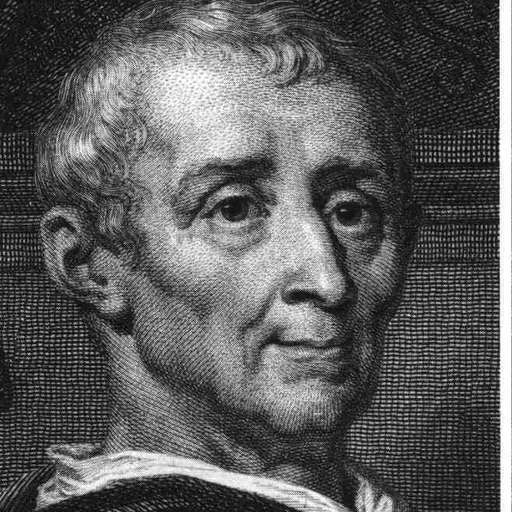
Charles-Louis de Secondat, baron de La Brède et de Montesquieu (English pronunciation: /ˈmɒntɨskjuː/; 18 January 1689, La Brède, Gironde – 10 February 1755), was a French social commentator and political thinker who lived during the Era of the Enlightenment. He is famous for his articulation of the theory of separation of powers, taken for granted in modern discussions of government and implemented in many constitutions throughout the world. He was largely responsible for the popularization of the terms feudalism and Byzantine Empire. After having studied at the Catholic College of Juilly, Charles-Louis de Secondat married. His wife, Jeanne de Lartigue, a Protestant, brought him a substantial dowry when he was 26. The next year, he inherited a fortune upon the death of his uncle, as well as the title Baron de Montesquieu and Président à Mortier in the Parliament of Bordeaux. By that time, England had declared itself a constitutional monarchy in the...
2 poezii, 0 proze
Kurt Weill
Biography Early Years Kurt Weill was born on 2 March 1900 in Dessau, Germany. The son of a cantor, Weill displayed musical talent early on. By the time he was twelve, he was composing and mounting concerts and dramatic works in the hall above his family\'s quarters in the Gemeindehaus. During the First World War, the teenage Weill was conscripted as a substitute accompanist at the Dessau Court Theater. After studying theory and composition with Albert Bing, Kapellmeister of the Theater, Weill enrolled at the Berlin Hochschule für Musik, but found the conservative training and the infrequent lessons with Engelbert Humperdinck too stifling. After a season as conductor of the newly formed municipal theater in Lüdenscheid, he returned to Berlin and was accepted into Ferruccio Busoni\'s master class in composition. He supported himself through a wide range of musical occupations, from playing organ in a synagogue to piano in a Bierkeller, by tutoring students (including Claudio Arrau and...
1 poezii, 0 proze
 A
AA
.
7 poezii, 0 proze
a
asdasdasd
10 poezii, 0 proze
 A
Aa
1 poezii, 0 proze
 A
AA
1 poezii, 0 proze
A
M
6 poezii, 0 proze
 A
Aa
1 poezii, 0 proze
A
2 poezii, 0 proze
Cum citesc eu un articol
de Elena Malec
O dimineață de iunie.Deschid pagina web de poezie-agonie. Atenția mi-e atrasă de un titlu „Arienii si lumea de azi” articol [ Societate ] Zic, iată ceva nou.Ce s-o mai fi spus la teoria-dispută veche...
Liberalismul în câteva cuvinte
de Claudiu Dobre
Sartori consideră că - fiind necesară distincție între liberism/liberalism, între libertate/liberalism, liberalismul filosofic/praxisul liberalist și libertățile politice/libertățile extrapolitice-,...
Albert Einstein\'s Words on Spirituality and Religion
de Albert Einstein
(The following quotes are taken from The Quotable Einstein, Princeton University Press unless otherwise noted) \"My religion consists of a humble admiration of the illimitable superior spirit who...
Un os de ros
de Ghejan Andrei
… sau ce mai publică alte reviste. Uite, de exemplu Revista Agero, probabil în necunoștință de cauză, este chiar onorată în: http://www.agero-stuttgart.de/REVISTA-AGERO/CULTURA/Brancusi%20cu%20Romeo%2...
De la ,,Teoria Speciilor Informaționale” la ,,Invenție”
de cornel marginean
Ce este în fapt o ,,Invenție”? Este o ,,informație anume” ascunsă în însăși firea lucrurilor, utilă și revoluționară pentru un domeniu, la care nu s-a gândit nimeni până în momentul descoperirii...
Paradoxismul in stiinta
de Florentin Smarandache
Paradoxismul se intampla in mod natural, nu este o fortare, o falsificare. Nici o alta avangarda literara nu s-a intamplat sa fie folosita in stiinta. Sa dau un exemplu din cibernetica, robotica,...