
"To Himself" – 5730 rezultate
0.02 secundeMeilisearch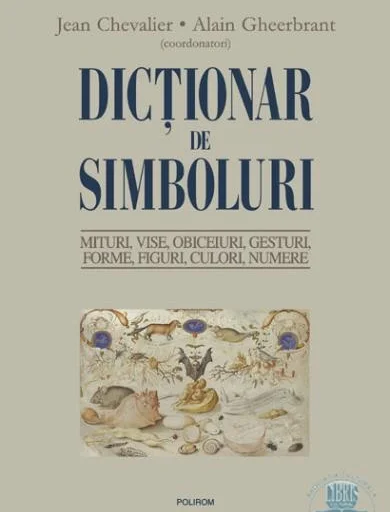 JC
JCJean Chevalier
Jean Chevalier (1906-1993) was a university lecturer in philosophy and theology before working for UNESCO, where he was Director of Relations for Member States. He left in 1964 to devote himself to writing and research. He published many works on topics such as St Augustine, Descartes, African religion, Sufism, human spirituality and transcendental meditation. Jean Chevalier is the author of The Penguin Dictionary of Symbols (Dictionary, Penguin), and has 7 books that have been rated 70 times on Goodreads. Intr-o epoca in care imaginatia este revalorificata ca resort al descoperirilor si progresului, dictionarul coordonat de Jean Chevalier si Alain Gheerbrant ilustreaza varietatea cheilor de interpretare – oficiale si subversive, analitice si emotionale, spirituale si sexuale – oferite in diferite culturi simbolurilor fundamentale ale omenirii. Cu informatii din cele mai diverse domenii, de la teologie si astrologie la psihanaliza sau publicitate, si avind la baza surse folclorice,...
2 poezii, 0 proze
 JS
JSJaime Sabines
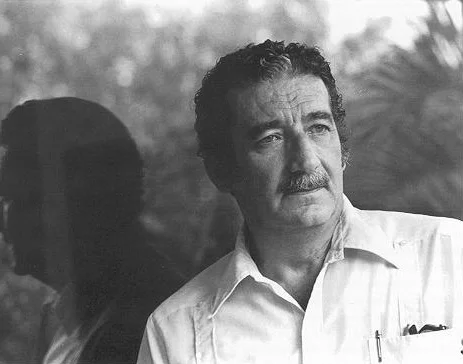
Jaime Sabines Gutiérrez (March 25, 1926 - March 19, 1999) is arguably Mexico's most influential contemporary poet. Known as “the sniper of Literature” as he formed part of a group that transformed literature into reality, he wrote ten volumes of poetry, and his work has been translated into more than twelve languages. His writings chronicle the experience of everyday people in places such as the street, hospital, and playground. Sabines was also a politician. Jaime Sabines was born on March 25, 1926 in Tuxtla Gutiérrez, Chiapas. Before he devoted himself to the study of literature, he spent three years studying medicine before moving on to his real vocation: Spanish and literature, studying at the Universidad Nacional Autónoma de México (UNAM), and obtaining a postgraduate degree. Sabines was an outstanding student at the Mexican Writers Centre from 1964 to 1965 and part of the jury for the Casa de las Americas prize. In addition to his literary activity, he participated in politics...
8 poezii, 0 proze
John Steinbeck
John Steinbeck (1902-1968), born in Salinas, California, came from a family of moderate means. He worked his way through college at Stanford University but never graduated. In 1925 he went to New York, where he tried for a few years to establish himself as a free-lance writer, but he failed and returned to California. After publishing some novels and short stories, Steinbeck first became widely known with Tortilla Flat (1935), a series of humorous stories about Monterey paisanos. Steinbeck's novels can all be classified as social novels dealing with the economic problems of rural labour, but there is also a streak of worship of the soil in his books, which does not always agree with his matter-of-fact sociological approach. After the rough and earthy humour of Tortilla Flat, he moved on to more serious fiction, often aggressive in its social criticism, to In Dubious Battle (1936), which deals with the strikes of the migratory fruit pickers on California plantations. This was followed...
4 poezii, 0 proze
 SC
SCSamuel Taylor Coleridge
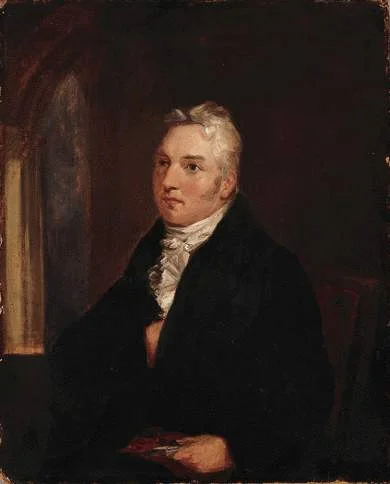
Samuel Taylor "Estese" Coleridge (1772-1834) Samuel Taylor Coleridge was born in Ottery St. Mary on 21 October 1772, youngest of the ten children of John Coleridge, a minister, and Ann Bowden Coleridge. He was often bullied as a child by Frank, the next youngest, and his mother was apparently a bit distant, so it was no surprise when Col1 ran away at age seven. He was found early the next morning by a neighbor, but the events of his night outdoors frequently showed up in imagery in his poems (and his nightmares) as well as the notebooks he kept for most of his adult life. John Coleridge died in 1781, and Col was sent away to a London charity school for children of the clergy. He stayed with his maternal uncle2. Col was really quite a prodigy; he devoured books and eventually earned first place in his class. His brother Luke died in 1790 and his only sister Ann in 1791, inspiring Col to write "Monody," one of his first poems, in which he likens himself to Thomas Chatterton3. Col was...
22 poezii, 0 proze
 JC
JCJim Carroll
James Dennis "Jim" Carroll (August 1, 1949 – September 11, 2009) was an author, poet, autobiographer, and punk musician. Carroll was best known for his 1978 autobiographical work The Basketball Diaries, which was made into the 1995 film of the same name, starring Leonardo DiCaprio as Carroll. Carroll was of Irish descent and attended Roman Catholic grammar schools from 1955 to 1963. In fall 1963, he entered public school, but was soon awarded a scholarship to the elite private school Trinity School (New York). He entered Trinity High School in 1964. Apart from being interested in writing, Carroll was an all-star basketball player throughout his grade school and high school career. He entered the "Biddy League" at age 13 and participated in the National High School All Star Game in 1966. During this time, Carroll was living a double life as a heroin addict who prostituted himself to afford his habit, but was also writing poems and attending poetry workshops at St. Mark's Poetry...
4 poezii, 0 proze
 GH
GHGerard Manley Hopkins
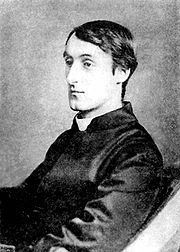
Gerard Manley Hopkins, S.J. (28 July 1844 – 8 June 1889), was an English poet, Roman Catholic convert, and Jesuit priest, whose 20th-century fame established him posthumously among the leading Victorian poets. His experimental explorations in prosody (especially sprung rhythm) and his use of imagery established him as a daring innovator in a period of largely traditional verse. He was educated at Highgate School and then Balliol College, Oxford, where he studied classics. Hopkins was an unusually sensitive student and poet, as witnessed by his class-notes and early poetic pieces. It was at Oxford that he forged a friendship with Robert Bridges (eventual Poet Laureate of England) which would be of importance in his development as a poet, and his posthumous acclaim. Hopkins began his time in Oxford as a keen socialite and prolific poet, but he seemed to have alarmed himself with the changes in his behaviour that resulted, and he became more studious and began recording his sins in his...
1 poezii, 0 proze
 PW
PWPeter Weiss
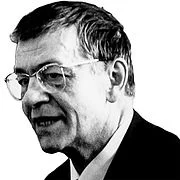
Peter Ulrich Weiss (November 8, 1916 – May 10, 1982) was a German writer, painter, and artist of adopted Swedish nationality. He is particularly known for his play Marat/Sade and his novel The Aesthetics of Resistance. Weiss was born in Nowawes (now part of Potsdam-Babelsberg), Brandenburg, to a Hungarian Jewish father and Christian mother. At age three he moved with his family to Bremen, and then during his adolescence to Berlin where Weiss began training for a career as a visual artist. In 1934 he emigrated with his family to Chislehurst, near London, England, where he studied photography at the Polytechnic School of Photography, and then in 1937-1938 attended the Prague Art Academy. After the German occupation of the Sudetenland in 1938, his family moved to Sweden, and Weiss himself removed to Switzerland. In 1939 he again emigrated to Stockholm, Sweden, where he lived for the rest of his life. He became a Swedish citizen in 1946. Weiss was married three times: to the painter Helga...
0 poezii, 0 proze
 LN
LNLassi Nummi
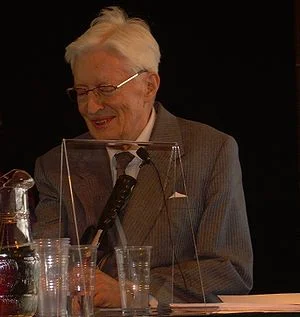
Lassi Nummi (born 1928) considers himself a prose-writer who has strayed into poetry. In a career spanning almost half a century and 25 collections of poetry, his preoccupations, and his central metaphors, have remained constant: landscape, trees, bushes, blades of grass. Interview by Tarja Roinila; poems translated by Herbert Lomas and Anselm Hollo 'During my "social period" I was on the board of the Writers' Union, and its chairman from 1969 to 1972; after that I worked for the Uusi Suomi newspaper and for the PEN Club, whose chairman I was from 1983 to 1988. I was a member of the Bible translation committee for the entire period of its existence, 17 years. A completely different choice would have been to become either a Buddhist or a Christian monk, or then to be a really convinced down-and-out- that might have been the most elegant solution. One could have regulated one's liquid intake, but the freedom of movement would have been pleasant. At the moment I am working out how much...
2 poezii, 0 proze
 RS
RSRobert Louis Stevenson
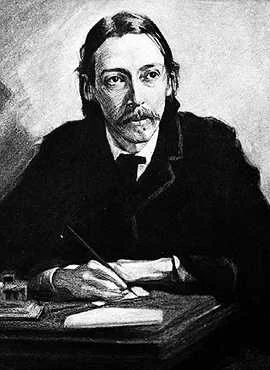
13 noiembrie 1850 - 3 decembrie 1894 Robert Louis Stevenson was born to Thomas and Margaret Isabella Balfour Stevenson in Edinburgh on 13 November 1850. From the beginning he was sickly. Through much of his childhood he was attended by his faithful nurse, Alison Cunningham, known as Cummy in the family circle. She told him morbid stories about the Covenanters (the Scots Presbyterian martyrs), read aloud to him Victorian penny-serial novels, Bible stories, and the Psalms, and drilled the catechism into him, all with his parents' approval. Thomas Stevenson was quite a storyteller himself, and his wife doted on their only child, sitting in admiration while her precocious son expounded on religious dogma. Stevenson inevitably reacted to the morbidity of his religious education and to the stiffness of his family's middle-class values, but that rebellion would come only after he entered Edinburgh University.
1 poezii, 0 proze
 NP
NPNicanor Parra
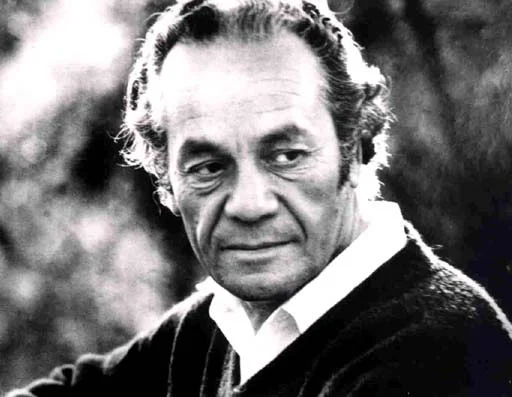
Nicanor Parra Sandoval (born in San Fabián de Alico, Chile on September 5, 1914) is a mathematician and poet often considered to be the most influential poet Chile has produced since Pablo Neruda.[citation needed] He describes himself as an "antipoet," due to his distaste for standard poetic pomp and function (after recitations he would exclaim Me retracto de todo lo dicho, or, "I take back everything I said"). Trying to get away from the conventions of poetry, Parra's poetic language renounces the refinement of most Latin American literature and adopts a more colloquial tone similar to prose. His first collection, "Poemas y Antipoemas" (1954) is a classic of Latin American literature, one of the most influential Spanish poetry collections of the twentieth century, and is cited as an inspiration by American Beat Writers such as Allen Ginsberg. Parra has been nominated several times for the Nobel Prize in Literature. Parra comes from the artistically prolific Chilean Parra family of...
2 poezii, 0 proze
To Himself
de Giacomo Leopardi
Now will you rest forever, My tired heart. Dead is the last deception, That I thought eternal. Dead. Well I feel In us the sweet illusions, Nothing but ash, desire burned out. Rest forever. You have...
Summa Theologica
de Thomas Aquinas
fragment.. Objection 1. It seems that there are no ideas. For Dionysius says (Div. Nom. vii), that God does not know things by ideas. But ideas are for nothing else except that things may be known...
The Wood-Pile
de Robert Frost
Out walking in the frozen swamp one gray day I paused and said, \'I will turn back from here. No, I will go on farther- and we shall see\'. The hard snow held me, save where now and then One foot...
Păianjenul ține în Mîini nevăzute
de Emily Dickinson
Păianjentul ține în Mîini nevăzute Un Ghem de Argint - lucitor - Dansează liniștit de Unul Singur Grăuntele de Perlă desfăcîndu-și ușor - El zămislește din Nimic Nimic - O Îndeletnicire ireală - Ne...
Gnomic Verses
de William Blake
i Great things are done when men and mountains meet; This is not done by jostling in the street. ii To God If you have form\'d a circle to go into, Go into it yourself, and see how you would do. iii...
The Use and Abuse of History
de Friedrich Nietzsche
The Use and Abuse of History (1878) By Friedrich Nietzsche Forward \"Incidentally, I despise everything which merely instructs me without increasing or immediately enlivening my activity.\" These are...
PARADISE LOST -- Book XII
de John Milton
Book XII As one who in his journey bates at noon, Though bent on speed; so here the Arch-Angel paused Betwixt the world destroyed and world restored, If Adam aught perhaps might interpose; Then, with...
Beyond Good and Evil
de Friedrich Nietzsche
On the Prejudices of Philosophers 1 The will to truth which will still tempt us to many a venture, that famous truthfulness of which all philosophers so far have spoken with respect - what questions...
Crow\'s Fall
de Ted Hughes
When Crow was white he decided the sun was too white. He decided it glared much too whitely. He decided to attack it and defeat it. He got his strength up flush and in full glitter. He clawed and...
The Death of the Hired Man
de Robert Frost
Mary sat musing on the lamp-flame at the table Waiting for Warren. When she heard his step, She ran on tip-toe down the darkened passage To meet him in the doorway with the news And put him on his...