
"It was an April morning, fresh and clear" – 4372 rezultate
0.02 secundeMeilisearchJakob Bohme
Jakob Böhme (probably April 24, 1575[1] – November 17, 1624) was a German Christian mystic and theologian. He is considered an original thinker within the Lutheran tradition. In contemporary English, his name may be spelled Jacob Boehme; in seventeenth-century England it was also spelled Behmen, approximating the contemporary English pronunciation of the German Böhme.
1 poezii, 0 proze
 AB
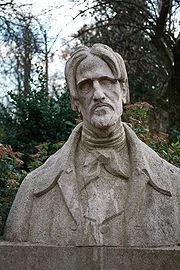
ABAloysius Bertrand
Louis-Jacques-Napoléon “Aloysius” Bertrand (20 April 1807 – 29 April 1841) was a French poet instrumental in the introduction of the prose poem into French literature and is credited with inspiring later Symbolist poets [1]. He wrote a collection of poems entitled Gaspard de la nuit, after which composer Maurice Ravel wrote a suite of the same name, based on the poems "Scarbo", "Ondine", and "Le Gibet". Bertrand was born in Ceva, Piedmont, Italy (then a part of Napoleonic France) and his family settled in Dijon in 1814. There he developed an interest in the Burgundian capital. His contributions to a local paper lead to recognition by Victor Hugo and Sainte-Beuve. He lived in Paris shortly with little success. He returned to Dijon and continued writing for local newspapers. Gaspard was sold in 1836 but it wasn't published until 1842 after his death of tuberculosis. The book was rediscovered by Charles Baudelaire and Stéphane Mallarmé. It is now considered a classic of poetic and...
8 poezii, 0 proze
Isaac Asimov
Biographical (non-literary) How do you pronounce \"Isaac Asimov\"? \"EYE\'zik AA\'zi-mov\". The name is spelled with an \"s\" and not a \"z\" because Asimov\'s father didn\'t understand the English alphabet clearly when the family moved to the U.S. in 1923. (In Russian, the spelling was the Cyrillic equivalent of Azimov, and in Yiddish, the Hebrew letters were aleph-zayin-yod-mem-aleph-vav-vav.) One way to remember this pronunciation is the pun from The Flying Sorcerers by Larry Niven and David Gerrold: \"As a color, shade of purple-grey\", or \"As a mauve\". Asimov wrote a poem (\"The Prime of Life\") in which he rhymes his surname with \"stars above\"; someone else suggested amending the poem to rhyme it with \"mazel tov\", which he thought an improvement. Asimov\'s own suggestion, however, as to how to remember his name was to say \"Has Him Off\" and leave out the H\'s. When did Asimov die? What was the cause of his death? Where is he buried? Asimov died on April 6, 1992 of heart...
0 poezii, 0 proze
 DG
DGDavid Gascoyne
David Gascoyne (October 10, 1916 - November 25, 2001) was an English poet associated with the Surrealist movement. Gascoyne was born in Harrow and grew up in England and Scotland and attended Salisbury Cathedral School and Regent Street Polytechnic in London. He spent part of the early 1930s in Paris. His first book, Roman Balcony and Other Poems, was published in 1932, when he was sixteen. A novel, Opening Day, was published the following year. However, it was Man's Life is This Meat (1936), which collected his early surrealist work and translations of French surrealists, and Hölderlin's Madness (1938) that established his reputation. These publications, together with his 1935 A Short Survey of Surrealism and his work on the 1936 London International Surrealist Exhibition, which he helped to organise, made him one of a small group of English surrealists that included Hugh Sykes Davies and Roger Roughton. Ironically, at this exhibition, Gascoyne had to rescue Salvador Dalí from the...
5 poezii, 0 proze
 GH
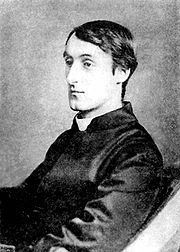
GHGerard Manley Hopkins
Gerard Manley Hopkins, S.J. (28 July 1844 – 8 June 1889), was an English poet, Roman Catholic convert, and Jesuit priest, whose 20th-century fame established him posthumously among the leading Victorian poets. His experimental explorations in prosody (especially sprung rhythm) and his use of imagery established him as a daring innovator in a period of largely traditional verse. He was educated at Highgate School and then Balliol College, Oxford, where he studied classics. Hopkins was an unusually sensitive student and poet, as witnessed by his class-notes and early poetic pieces. It was at Oxford that he forged a friendship with Robert Bridges (eventual Poet Laureate of England) which would be of importance in his development as a poet, and his posthumous acclaim. Hopkins began his time in Oxford as a keen socialite and prolific poet, but he seemed to have alarmed himself with the changes in his behaviour that resulted, and he became more studious and began recording his sins in his...
1 poezii, 0 proze
 MR
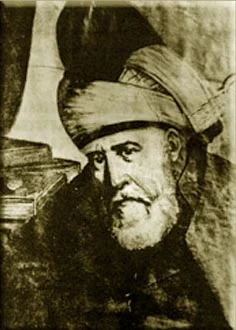
MRMevlana Jalaluddin Rumi
Mawlānā Jalāl ad-Dīn Muḥammad Balkhī, also known as Jalāl ad-Dīn Muḥammad Rūmī, but known to the English-speaking world simply as Rumi, (30 September 1207 – 17 December 1273), was a 13th-century Persian poet, Islamic jurist, theologian, and mystic. Rūmī is a descriptive name meaning "the Roman" since he lived most of his life in an area called Rūm because it was once ruled by the Byzantine Empire. According to tradition, Rumi was born in Balkh, Khorasan (now in Afghanistan), the hometown of his father's family. Scholars, however, argue that he was most likely born in Wakhsh, a small town located at the river Wakhsh in what is now Tajikistan. Wakhsh belonged to the larger province of Balkh, and in the year Rumi was born, his father was an appointed scholar there. Both these cities were at the time included in the Greater Persian cultural sphere of Khorasan, the easternmost province of historical Persia, and were...
162 poezii, 0 proze
 JR
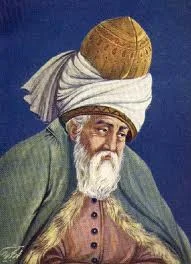
JRJalal ad-Dīn Muhammad Rumi
Jalāl ad-Dīn Muḥammad Balkhī, also known as Jalāl ad-Dīn Muḥammad Rūmī, and popularly known as Mowlānā but known to the English-speaking world simply as Rumi (30 September 1207 – 17 December 1273), was a 13th-century Persian (Tajik) Muslim poet, jurist, theologian, and Sufi mystic. Rūmī is a descriptive name meaning "the Roman" since he lived most of his life in an area called Rūm because it was once ruled by the Eastern Roman Empire. It is likely that he was born in the village of Wakhsh, a small town located at the river Wakhsh in what is now Tajikistan. Wakhsh belonged to the larger province of Balkh, and in the year Rumi was born, his father was an appointed scholar there. Both these cities were at the time included in the greater Persian cultural sphere of Khorasan, the easternmost province of Persia, and were part of the Khwarezmian Empire. Image of the Rumi on an old book in the Mevlâna museum; Konya,...
0 poezii, 0 proze
James Joyce
Joyce was born in Dublin, where his father was a rates collector. He was educated at a Jesuit school and University College, Dublin where he studied philosophy and language. When he was still an undergraduate, in 1900, his long review of Ibsen’s last play was published in the Fortnightly Review. At this time he also began writing his poems which were later collected in Chamber Music, published in 1907. In 1902 Joyce left Dublin for Paris, but returned the following year as his mother was dying. From 1904 he lived with Nora Barnacle, whom he married in 1931 (the year his father died), a son was born in 1905, and a daughter in 1918. Their home from 1905 to 1915 was Trieste, where Joyce taught English at the Berlitz school. In 1909 and 1912 he made his final trips to Ireland, attempting to arrange the publication of his first book Dubliners, which finally appeared in England in 1914. It was during this time that he was contacted by Ezra Pound, a leading champion of modernist writers who...
0 poezii, 0 proze
 WH
WHWilliam Ernest Henley
William Ernest Henley (23 August 1849 – 11 July 1903) was an English poet, critic and editor. Born 23 August 1849 Gloucester, England Died 11 July 1903 (aged 53) Occupation Poet, critic and editor Nationality English Education The Crypt School, Gloucester Writing period c. 1870–1903 Henley was born at Gloucester and was the eldest of a family of six, five sons and a daughter. His father, William, was a bookseller and stationer who died in 1868 leaving young children and creditors. His mother, Mary Morgan, was descended from the poet and critic, Joseph Warton. From 1861-67 Henley was a pupil at the Crypt Grammar School (founded 1539). A Commission had recently attempted to revive the school by securing the brilliant and academically distinguished T. E. Brown (1830-1897) as headmaster. Brown's appointment was short-lived (c.1857-63) but was a 'revelation' for Henley because it introduced him to a poet and 'man of genius - the first I'd ever seen'. This was the start of a lifelong...
1 poezii, 0 proze
 HF
HFHÖLDERLIN, Friedrich
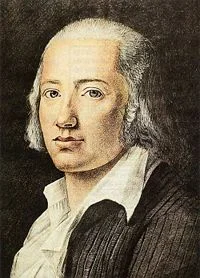
Johann Christian Friedrich Hölderlin (20 March 1770 – 6 June 1843) was a major German lyric poet. His work bridges the Classical and Romantic schools. Having spent most of his life tormented by mental illness, he suffered great loneliness, and often spent his time playing the piano, drawing, reading, writing, and enjoyed travelling when he had the chance. The poetry of Hölderlin, widely recognized today as one of the highest points of German literature, was little known or understood during his lifetime and slipped into obscurity shortly after his death; his illness and reclusion made him fade from his contemporaries' consciousness – and, even though selections of his work were being published by his friends already during his lifetime, it was largely ignored for the rest of the 19th century. In fact, Hölderlin was a man of his time, an early supporter of the French Revolution – in his youth at the Seminary of Tübingen, he and some colleagues from a "republican club" planted a "Tree...
22 poezii, 0 proze
Portrait of a Lady
de T.S. Eliot
Thou hast committed— Fornication: but that was in another country, And besides, the wench is dead. The Jew of Malta. I AMONG the smoke and fog of a December afternoon You have the scene arrange...
Davinci
de bataus cati georgiana
Leonardo da Vinci (1452 - 1519) Leonardo da Vinci was the embodiment of the Renaissance ideal of the universal man, the first artist to attain complete mastery over all branches of art. He was a...
Canto 49
de Ezra Pound
For the seven lakes, and by no man these verses: Rain; empty river; a voyage, Fire from frozen cloud, heavy rain in the twilight Under the cabin roof was one lantern. The reeds are heavy; bent; and...
The Telephone
de Robert Frost
\"When I was just as far as I could walk From here today, There was an hour All still When leaning with my head against a flower I heard you talk. Don\'t say I didn\'t, for I heard you say-- You...
The Dolls
de William Butler Yeats
A DOLL in the doll-makers house Looks at the cradle and balls: That is an insult to us. But the oldest of all the dolls Who had seen, being kept for show, Generations of his sort, Out-screams the...
Two Look at Two
de Robert Frost
Love and forgetting might have carried them A little further up the mountain side With night so near, but not much further up. They must have halted soon in any case With thoughts of a path back, how...
Dracula
de Bram Stoker
DRACULA (1897) written by Bram Stoker Chapter 1 - Jonathan Harker\'s Journal 3 May. Bistriz. Left Munich at 8:35 P.M., on 1st May, arriving at Vienna early next morning; should have arrived at 6:46,...
The Little Mermaid
de Radu Herinean
The Little Mermaid - - - - by Hans Christian Andersen Far out in the ocean, where the water is as blue as the prettiest cornflower, cornflower, and as clear as the purest glass. But it is very deep...
Dracula
de Bram Stoker
Chapter 7 - Cutting from \"the Dailygraph\". (Pasted in Mina Murray\'s Journal.) From a Correspondent. 8 August. Whitby One of the greatest and suddenest storms on record has just been experienced...
It was a time of triumph for the morons
de Alexandru Paleologu
Mr. Paleologu, to begin with, let us say that this talk is the result of certain hostile attitudes, especially in the Western media, concerning Mircea Eliade and what we call here “Generation ’27”. I...