
"Certainty" – 91 rezultate
0.01 secundeMeilisearch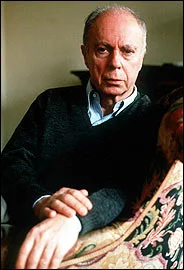 CS
CSClaude Simon
Claude Simon (10 October 1913, — 6 July 2005) was a French novelist and the 1985 Nobel Laureate in Literature. He was born in Antananarivo, Madagascar, and died in Paris, France. Simon is often identified with the nouveau roman movement exemplified in the works of Alain Robbe-Grillet and Michel Butor, and while his fragmented narratives certainly contain some of the formal disruption characteristic of that movement (in particular Triptyque from 1973), he nevertheless retains a strong sense of narrative and character. In fact, Simon arguably has much more in common with his Modernist predecessors than with his contemporaries; in particular, the works of Marcel Proust and William Faulkner are a clear influence. Simon's use of self-consciously long sentences (often stretching across many pages and with parentheses sometimes interrupting a clause which is only completed pages later) can be seen to reference Proust's own style, and Simon morever makes use of certain Proustian settings (in...
0 poezii, 0 proze
Don Miguel de Cervantes y Saavedra
It is not known for certain the exact date of his birth, but since according to Spanish tradition the Christening was carried through very closely after the birth, there is no doubt that his birthday was in 1547. The actual date of the Christening was October 9th, 1547 at the city of Alcala de Henares. Since then, little is known of his childhood, other than he lived with his family in Valladolid, Madrid, and other Andalusian cities. Finally, they settled in Madrid, and afterwards, he became the attendant to the Cardinal Acquaviva in Italy in 1569 . Later on, Cervantes enlisted in to armed forces for the naval Battle of Lepanto (it took place on the 7th of December of 1571) where he was injured. This meant the handicap of his left hand, but he still continued as a soldier, on his voyage returning to Spain 1575 in the galley Sun, he fell prisoner of the Turks when it was over powered. The next five years, Cervantes is a prisoner of war in Algiers, from where he tried to escape four...
1 poezii, 0 proze
 JB
JBJean de La Bruyère
He was born in Paris, not, as was once thought, at Dourdan (in today's Essonne département) in 1645. His family was middle class, and his reference to a certain Geoffroy de La Bruyère, a crusader, is only a satirical illustration of a method of self-ennoblement common in France as in some other countries. Indeed he himself always signed the name Delabruyère in one word, as evidence of this. He could trace his family back at least as far as his great-grandfather, who had been a strong Leaguer. La Bruyère's own father was controller general of finance to the Hôtel de Ville. The son was educated by the Oratorians and at the University of Orléans; he was called to the bar, and in 1673 bought a post in the revenue department at Caen, which gave him status and an income. His predecessor in the post was a relation of Jacques Benigne Bossuet, and it is thought that the transaction was the cause of La Bruyère's introduction to the great orator Bossuet, who from the date of his own...
3 poezii, 0 proze
Jean FANCHETTE
Jean FANCHETTE est né à Rose-Hill, île Maurice, le 6 mai 1932. Il a commencé ses études de Médecine en France à l\'âge de 19 ans et publie trés jeune, deux receuils de poésies qui seront consacrés par des prix prestigieux : le prix Paul Valery en 1956 pour son recueil de poésie \"les midis du sang\" et le prix Fénéon pour \"archipels\" en 1958. Il a publié plusieurs autres recueils de poésie \"Osmoses\" en 1954, \"Identité provisoire\" en 1965, \"je m\'appelle sommeil\" en 1977 et \"la visitation de l\'oiseau pluvier en 1977 qui lui a valu une correspondance admirative du grand poète français René CHAR Une large sélection de ses poèmes, dont certains inédits, a été effectué par les Editions Stock dont le plan a été conçu par Jean FANCHETTE lui-même plusieurs mois avant sa mort survenue à Paris en mars 1992. Ce recueil de poèmes intitulé \"L\'île Equinoxe\" a été édité en 1993 par les Editions Stock. Neuro-psychiatre et psychanalyste, Jean FANCHETTE est également l\'auteur d\'Essais et...
2 poezii, 0 proze
Jaime Sabines
Je te veux à aux dix heures du matin Je te veux à aux dix heures du matin, et aux onze, et aux douze du jour. Je te veux avec toute mon âme et avec tout mon corps, parfois, dans les après-midi de pluie. Mais à aux deux heures de l\'après-midi, ou aux trois, quand je me mettes à penser nous deux, et tu penses le repas ou au travail quotidien, ou dans les divertissements que tu n\'as pas, je me mets a te haiser sourdement, avec la moitié de la haine que je garde pour moi. Je retourne ensuite à t’aimer, quand nous nous coucherons et consigne que tu es faite pour moi, d\'une certaine manière me le dissent ton genou et ton ventre, que mes mains me convainquent de cela, et qui il n\'y a pas un autre lieu où je viens, où je vais, mieux que ton corps. Tu viens toute complète à ma rencontre, et les deux nous disparaissons un moment, nous nous mettons dans la bouche de Dieu, jusqu\'à ce que je te dise que j\'ai faim ou sommeil. Tous les jours je te veux et je te haïs irrémédiablement. Et il y a...
0 poezii, 0 proze
 BV
BVBernard de Ventadour
Bernard de Ventadour ( en ancien occitan Bernartz de Ventedorn ), né vers 1145 à Ventadour, mort après 1195, est l'un des plus célèbres troubadours. Sa Vie, très romancée car tirée des vidas écrites un demi-siècle plus tard par Uc de Saint-Circ, est mal connue. Il est dit fils d'un homme d'armes et d'une boulangère du château de Ventadour en Corrèze. Il n'est pas certain qu'il fût d'origine modeste et certains l'assimilent à un membre de la lignée des Ventadour qui mourut abbé de Saint-Martin de Tulle. Il devint le disciple de son seigneur, le vicomte Ebles III Lo Cantador qui l'instruisit dans l'art de la composition lyrique dite trobar. Il aurait composé ses premiers chants pour la femme du fils de ce seigneur, ce qui lui valut d'être chassé de Ventadour. Il suivit alors jusqu'en Angleterre la cour d'Aliénor d'Aquitaine devenue l'épouse du roi Henri II Plantagenet, puis passa au service de Raymond V de Toulouse pour, selon sa vida, finir sa vie à l'abbaye de Dalon. Ses chansons -...
4 poezii, 0 proze
 D(
D(Danielle Messia (MASHIAH)
C\'est le 27 octobre 1956 à Jaffa (Israël) que naît Danielle Mashiah de son vrai nom, en 1958 ses parents s\'installent en France dans la région parisienne. C\'est donc en France que Danielle grandit avec sa soeur Cécile, en 1960 son père quitte le foyer le divorce est prononcé, il part vivre aux Etats- Unis. Danielle déclara en 1981 : La chanson : Pourquoi tu m\'as abandonnée ? parle de ce déchirement Au début des années 70 Danielle intègre un groupe folk \"Les Grattons Labeur\" ils tournent dans la région d\'Orléans, parallèlement Danielle suit des cours d\'histoire à la faculté d\'Orléans. En 1977 le groupe sort un disque auto produit \"Le bal des sorciers\" diffusé sous le label de Môrice Bénin \"ABA\". Danielle participe aussi en tant de choriste sur certaines chansons de Môrice Bénin et ainsi que sur l\'album de Gaston Couté de Gérard Pierron (les mangeurs d\'terre). Mais Danielle veut voler de ses propres ailes, elle quitte le groupe et part sur les routes avec sa guitare que...
6 poezii, 0 proze
 GM
GMGuy Lévis Mano
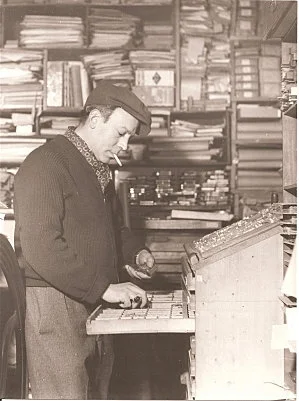
Guy Lévis Mano, né le 15 décembre 1904 à Salonique en Turquie, mort le 25 juillet 1980 à Vendranges dans la Loire, était un poète, traducteur, typographe, éditeur français. Il fut de 1923 à 1974 sous le sigle GLM un éditeur de poésie. Il est connu aussi sous le pseudonyme de Jean Garamond. Typographe par passion, imprimeur et poète, il compose lui-même et imprime des ouvrages et des plaquettes sur des papiers de grande qualité, avec plusieurs tirages dont certains sur des papiers de couleur pastel unie. Ses ouvrages sont fréquemment illustrés par des dessinateurs et des peintres aujourd'hui célèbres. Il attache un grand prix au choix des caractères, à la mise en page - en harmonie avec le support papier - et à l'illustration, ce en quoi il est un éditeur innovant. Il est également traducteur de poètes étrangers, espagnols notamment. Poète lui-même, son œuvre, qu'il édite tout au long de sa vie, est profondément marquée par cinq années de captivité en Allemagne comme prisonnier de...
1 poezii, 0 proze
 RG
RGRené Ghil
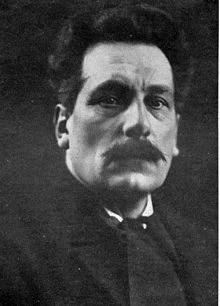
René François Ghilbert, dit René Ghil, né le 27 septembre 1862 à Tourcoing et mort le 15 septembre 1925 à Niort, est un poète "instrumentiste" et "scientifique" français. Salué par Mallarmé en 1885 dès son "volume d'essai", il rompit avec lui en 1888 sur la question de l'Idéalisme, auquel il opposait un matérialisme métaphysique inspiré de Darwin et du bouddhisme : il apparaît dès lors comme l' "adversaire du symbolisme" et de la "poésie égotiste". De 1887 à 1892, il dirigea les Écrits pour l'Art, première revue et premier groupe d'avant-garde de l'histoire ; puis il poursuivit son œuvre en solitaire, proche autour de 1900 de certains milieux anarcho-syndicalistes, encourageant les débuts d'un auteur comme Charles Louis Philippe. En décembre 1913, quelques jours avant Apollinaire, il enregistra aux "Archives de la Parole" son "Chant dans l'Espace" qui contient ce vers résumant toute sa conception du monde et de la poésie : Ma pensée est le monde en émoi de soi-même. L'œuvre poétique...
1 poezii, 0 proze
 MA
MAManuel Acuña
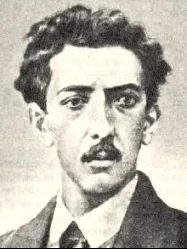
Manuel Acuña Narro (27 August 1849 – 6 December 1873) was a 19th-century Mexican writer. He focused on poetry, but also wrote some novels and plays. Even though he was famous at an early time of his life, he decided to commit suicide. It is not certain why he killed himself, but it is thought that he did so because of a woman. Acuña was born in the city of Saltillo, Coahuila, on August 27, 1849 to Francisco Acuña and Refugio Narro. He was taught how to write and read at an early age. Later he studied in the “Colegio Josefino”, in Saltillo. Around 1865 he was transferred to Mexico City to the School of San Ildefonso, where he entered as a full time student. Here he studied mathematics, Latin, French and philosophy. Acuña lived at a time at which Mexican society was dominated by philosophical-positivist intellectuality. Furthermore he was living as a romantic tendency in poetry was occurring. In January 1868, Acuña initiated his studies in medicine at the...
1 poezii, 0 proze
The Use and Abuse of History
de Friedrich Nietzsche
The Use and Abuse of History (1878) By Friedrich Nietzsche Forward \"Incidentally, I despise everything which merely instructs me without increasing or immediately enlivening my activity.\" These are...
Haiku și tanka
de Marian Nicolae TOMI
* ceaiul dă în foc - the tea is boiling - cu ochii pierduți pe câmp the eyes lost on the field închizând geamul closing the window * privind un lemn uscat – looking at a dry log - înflorind fără...
MILKY WAY - Sonet XIII
de Olavo Bilac
\"Well (thou´ll say) hearing stars! Certainly Thou´ve lost your mind!\" And I´ll say to thee, however That, to hear them, many times I wake And open the windows, palid in awe... And we talk all night...
On Looking Up by Chance at the Constellations
de Robert Frost
You\'ll wait a long, long time for anything much To happen in heaven beyond the floats of cloud And the Northern Lights that run like tingling nerves. The sun and moon get crossed, but they never...
Voices in vain
de Culcean Calin Lucian
Convinced to build the world anew, God took the sun and turn it cold, Divided earth in many little churches, One for each soul of young and old… …The time has come… My mind, is full of sorrow, My...
On Truth and Lies in a Nonmoral Sense
de Friedrich Nietzsche
On Truth and Lies in a Nonmoral Sense (1873) By Friedrich Nietzsche Once upon a time, in some out of the way corner of that universe which is dispersed into numberless twinkling solar systems, there...
Gnomic Verses
de William Blake
i Great things are done when men and mountains meet; This is not done by jostling in the street. ii To God If you have form\'d a circle to go into, Go into it yourself, and see how you would do. iii...
Way Of The Souls
de Octav Chivulescu
ISBN 973-0-03999-2 Noita R. Ipsni WAY OF THE SOULS * OURSELVES CIVILIZATION OF THE INS SOURCE OF LIGHT ARCHAEOLOGY OF THE FUTURE COLLECTION OF THOUGHTS CHAPTER 666 TRACES IN THE SAND Computer...
The Last Question
de Isaac Asimov
The last question was asked for the first time, half in jest, on May 21, 2061, at a time when humanity first stepped into the light. The question came about as a result of a five-dollar bet over...
never the same: Romania and Bulgaria
de Felix-Gabriel Lefter
Never the same: Romania and Bulgaria Suspicious, holding the blade in trembling hands, always carrying on each other trouble, or superiority, as it takes, competing, hating, trying to do something...