
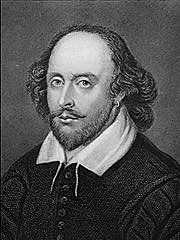
Scenariu
Hamlet
(pg 8) ACT IV/V
23 min lectură·
Mediu
HAMLET
DRAMATIS PERSONAE
(PAGINA 8)
ACT IV
SCENE VI Another room in the castle.
[Enter HORATIO and a Servant]
HORATIO What are they that would speak with me?
Servant Sailors, sir: they say they have letters for you.
HORATIO Let them come in.
[Exit Servant]
I do not know from what part of the world
I should be greeted, if not from Lord Hamlet.
[Enter Sailors]
First Sailor God bless you, sir.
HORATIO Let him bless thee too.
First Sailor He shall, sir, an\'t please him. There\'s a letter for
you, sir; it comes from the ambassador that was
bound for England; if your name be Horatio, as I am
let to know it is.
HORATIO [Reads] \'Horatio, when thou shalt have overlooked
this, give these fellows some means to the king:
they have letters for him. Ere we were two days old
at sea, a pirate of very warlike appointment gave us
chase. Finding ourselves too slow of sail, we put on
a compelled valour, and in the grapple I boarded
them: on the instant they got clear of our ship; so
I alone became their prisoner. They have dealt with
me like thieves of mercy: but they knew what they
did; I am to do a good turn for them. Let the king
have the letters I have sent; and repair thou to me
with as much speed as thou wouldst fly death. I
have words to speak in thine ear will make thee
dumb; yet are they much too light for the bore of
the matter. These good fellows will bring thee
where I am. Rosencrantz and Guildenstern hold their
course for England: of them I have much to tell
thee. Farewell.
\'He that thou knowest thine, HAMLET.\'
Come, I will make you way for these your letters;
And do\'t the speedier, that you may direct me
To him from whom you brought them.
[Exeunt]
~~~
HAMLET
ACT IV
SCENE VII Another room in the castle.
[Enter KING CLAUDIUS and LAERTES]
KING CLAUDIUS Now must your conscience my acquaintance seal,
And you must put me in your heart for friend,
Sith you have heard, and with a knowing ear,
That he which hath your noble father slain
Pursued my life.
LAERTES It well appears: but tell me
Why you proceeded not against these feats,
So crimeful and so capital in nature,
As by your safety, wisdom, all things else,
You mainly were stirr\'d up.
KING CLAUDIUS O, for two special reasons;
Which may to you, perhaps, seem much unsinew\'d,
But yet to me they are strong. The queen his mother
Lives almost by his looks; and for myself--
My virtue or my plague, be it either which--
She\'s so conjunctive to my life and soul,
That, as the star moves not but in his sphere,
I could not but by her. The other motive,
Why to a public count I might not go,
Is the great love the general gender bear him;
Who, dipping all his faults in their affection,
Would, like the spring that turneth wood to stone,
Convert his gyves to graces; so that my arrows,
Too slightly timber\'d for so loud a wind,
Would have reverted to my bow again,
And not where I had aim\'d them.
LAERTES And so have I a noble father lost;
A sister driven into desperate terms,
Whose worth, if praises may go back again,
Stood challenger on mount of all the age
For her perfections: but my revenge will come.
KING CLAUDIUS Break not your sleeps for that: you must not think
That we are made of stuff so flat and dull
That we can let our beard be shook with danger
And think it pastime. You shortly shall hear more:
I loved your father, and we love ourself;
And that, I hope, will teach you to imagine--
[Enter a Messenger]
How now! what news?
Messenger Letters, my lord, from Hamlet:
This to your majesty; this to the queen.
KING CLAUDIUS From Hamlet! who brought them?
Messenger Sailors, my lord, they say; I saw them not:
They were given me by Claudio; he received them
Of him that brought them.
KING CLAUDIUS Laertes, you shall hear them. Leave us.
[Exit Messenger]
[Reads]
\'High and mighty, You shall know I am set naked on
your kingdom. To-morrow shall I beg leave to see
your kingly eyes: when I shall, first asking your
pardon thereunto, recount the occasion of my sudden
and more strange return. \'HAMLET.\'
What should this mean? Are all the rest come back?
Or is it some abuse, and no such thing?
LAERTES Know you the hand?
KING CLAUDIUS \'Tis Hamlets character. \'Naked!
And in a postscript here, he says \'alone.\'
Can you advise me?
LAERTES I\'m lost in it, my lord. But let him come;
It warms the very sickness in my heart,
That I shall live and tell him to his teeth,
\'Thus didest thou.\'
KING CLAUDIUS If it be so, Laertes--
As how should it be so? how otherwise?--
Will you be ruled by me?
LAERTES Ay, my lord;
So you will not o\'errule me to a peace.
KING CLAUDIUS To thine own peace. If he be now return\'d,
As checking at his voyage, and that he means
No more to undertake it, I will work him
To an exploit, now ripe in my device,
Under the which he shall not choose but fall:
And for his death no wind of blame shall breathe,
But even his mother shall uncharge the practise
And call it accident.
LAERTES My lord, I will be ruled;
The rather, if you could devise it so
That I might be the organ.
KING CLAUDIUS It falls right.
You have been talk\'d of since your travel much,
And that in Hamlet\'s hearing, for a quality
Wherein, they say, you shine: your sum of parts
Did not together pluck such envy from him
As did that one, and that, in my regard,
Of the unworthiest siege.
LAERTES What part is that, my lord?
KING CLAUDIUS A very riband in the cap of youth,
Yet needful too; for youth no less becomes
The light and careless livery that it wears
Than settled age his sables and his weeds,
Importing health and graveness. Two months since,
Here was a gentleman of Normandy:--
I\'ve seen myself, and served against, the French,
And they can well on horseback: but this gallant
Had witchcraft in\'t; he grew unto his seat;
And to such wondrous doing brought his horse,
As he had been incorpsed and demi-natured
With the brave beast: so far he topp\'d my thought,
That I, in forgery of shapes and tricks,
Come short of what he did.
LAERTES A Norman was\'t?
KING CLAUDIUS A Norman.
LAERTES Upon my life, Lamond.
KING CLAUDIUS The very same.
LAERTES I know him well: he is the brooch indeed
And gem of all the nation.
KING CLAUDIUS He made confession of you,
And gave you such a masterly report
For art and exercise in your defence
And for your rapier most especially,
That he cried out, \'twould be a sight indeed,
If one could match you: the scrimers of their nation,
He swore, had had neither motion, guard, nor eye,
If you opposed them. Sir, this report of his
Did Hamlet so envenom with his envy
That he could nothing do but wish and beg
Your sudden coming o\'er, to play with him.
Now, out of this,--
LAERTES What out of this, my lord?
KING CLAUDIUS Laertes, was your father dear to you?
Or are you like the painting of a sorrow,
A face without a heart?
LAERTES Why ask you this?
KING CLAUDIUS Not that I think you did not love your father;
But that I know love is begun by time;
And that I see, in passages of proof,
Time qualifies the spark and fire of it.
There lives within the very flame of love
A kind of wick or snuff that will abate it;
And nothing is at a like goodness still;
For goodness, growing to a plurisy,
Dies in his own too much: that we would do
We should do when we would; for this \'would\' changes
And hath abatements and delays as many
As there are tongues, are hands, are accidents;
And then this \'should\' is like a spendthrift sigh,
That hurts by easing. But, to the quick o\' the ulcer:--
Hamlet comes back: what would you undertake,
To show yourself your father\'s son in deed
More than in words?
LAERTES To cut his throat i\' the church.
KING CLAUDIUS No place, indeed, should murder sanctuarize;
Revenge should have no bounds. But, good Laertes,
Will you do this, keep close within your chamber.
Hamlet return\'d shall know you are come home:
We\'ll put on those shall praise your excellence
And set a double varnish on the fame
The Frenchman gave you, bring you in fine together
And wager on your heads: he, being remiss,
Most generous and free from all contriving,
Will not peruse the foils; so that, with ease,
Or with a little shuffling, you may choose
A sword unbated, and in a pass of practise
Requite him for your father.
LAERTES I will do\'t:
And, for that purpose, I\'ll anoint my sword.
I bought an unction of a mountebank,
So mortal that, but dip a knife in it,
Where it draws blood no cataplasm so rare,
Collected from all simples that have virtue
Under the moon, can save the thing from death
That is but scratch\'d withal: I\'ll touch my point
With this contagion, that, if I gall him slightly,
It may be death.
KING CLAUDIUS Let\'s further think of this;
Weigh what convenience both of time and means
May fit us to our shape: if this should fail,
And that our drift look through our bad performance,
\'Twere better not assay\'d: therefore this project
Should have a back or second, that might hold,
If this should blast in proof. Soft! let me see:
We\'ll make a solemn wager on your cunnings: I ha\'t.
When in your motion you are hot and dry--
As make your bouts more violent to that end--
And that he calls for drink, I\'ll have prepared him
A chalice for the nonce, whereon but sipping,
If he by chance escape your venom\'d stuck,
Our purpose may hold there.
[Enter QUEEN GERTRUDE]
How now, sweet queen!
QUEEN GERTRUDE One woe doth tread upon another\'s heel,
So fast they follow; your sister\'s drown\'d, Laertes.
LAERTES Drown\'d! O, where?
QUEEN GERTRUDE There is a willow grows aslant a brook,
That shows his hoar leaves in the glassy stream;
There with fantastic garlands did she come
Of crow-flowers, nettles, daisies, and long purples
That liberal shepherds give a grosser name,
But our cold maids do dead men\'s fingers call them:
There, on the pendent boughs her coronet weeds
Clambering to hang, an envious sliver broke;
When down her weedy trophies and herself
Fell in the weeping brook. Her clothes spread wide;
And, mermaid-like, awhile they bore her up:
Which time she chanted snatches of old tunes;
As one incapable of her own distress,
Or like a creature native and indued
Unto that element: but long it could not be
Till that her garments, heavy with their drink,
Pull\'d the poor wretch from her melodious lay
To muddy death.
LAERTES Alas, then, she is drown\'d?
QUEEN GERTRUDE Drown\'d, drown\'d.
LAERTES Too much of water hast thou, poor Ophelia,
And therefore I forbid my tears: but yet
It is our trick; nature her custom holds,
Let shame say what it will: when these are gone,
The woman will be out. Adieu, my lord:
I have a speech of fire, that fain would blaze,
But that this folly douts it.
[Exit]
KING CLAUDIUS Let\'s follow, Gertrude:
How much I had to do to calm his rage!
Now fear I this will give it start again;
Therefore let\'s follow.
[Exeunt]
~~~
HAMLET
ACT V
SCENE I A churchyard.
[Enter two Clowns, with spades, &c]
First Clown Is she to be buried in Christian burial that
wilfully seeks her own salvation?
Second Clown I tell thee she is: and therefore make her grave
straight: the crowner hath sat on her, and finds it
Christian burial.
First Clown How can that be, unless she drowned herself in her
own defence?
Second Clown Why, \'tis found so.
First Clown It must be \'se offendendo;\' it cannot be else. For
here lies the point: if I drown myself wittingly,
it argues an act: and an act hath three branches: it
is, to act, to do, to perform: argal, she drowned
herself wittingly.
Second Clown Nay, but hear you, goodman delver,--
First Clown Give me leave. Here lies the water; good: here
stands the man; good; if the man go to this water,
and drown himself, it is, will he, nill he, he
goes,--mark you that; but if the water come to him
and drown him, he drowns not himself: argal, he
that is not guilty of his own death shortens not his own life.
Second Clown But is this law?
First Clown Ay, marry, is\'t; crowner\'s quest law.
Second Clown Will you ha\' the truth on\'t? If this had not been
a gentlewoman, she should have been buried out o\'
Christian burial.
First Clown Why, there thou say\'st: and the more pity that
great folk should have countenance in this world to
drown or hang themselves, more than their even
Christian. Come, my spade. There is no ancient
gentleman but gardeners, ditchers, and grave-makers:
they hold up Adam\'s profession.
Second Clown Was he a gentleman?
First Clown He was the first that ever bore arms.
Second Clown Why, he had none.
First Clown What, art a heathen? How dost thou understand the
Scripture? The Scripture says \'Adam digged:\'
could he dig without arms? I\'ll put another
question to thee: if thou answerest me not to the
purpose, confess thyself--
Second Clown Go to.
First Clown What is he that builds stronger than either the
mason, the shipwright, or the carpenter?
Second Clown The gallows-maker; for that frame outlives a
thousand tenants.
First Clown I like thy wit well, in good faith: the gallows
does well; but how does it well? it does well to
those that do in: now thou dost ill to say the
gallows is built stronger than the church: argal,
the gallows may do well to thee. To\'t again, come.
Second Clown \'Who builds stronger than a mason, a shipwright, or
a carpenter?\'
First Clown Ay, tell me that, and unyoke.
Second Clown Marry, now I can tell.
First Clown To\'t.
Second Clown Mass, I cannot tell.
[Enter HAMLET and HORATIO, at a distance]
First Clown Cudgel thy brains no more about it, for your dull
ass will not mend his pace with beating; and, when
you are asked this question next, say \'a
grave-maker: \'the houses that he makes last till
doomsday. Go, get thee to Yaughan: fetch me a
stoup of liquor.
[Exit Second Clown]
[He digs and sings]
In youth, when I did love, did love,
Methought it was very sweet,
To contract, O, the time, for, ah, my behove,
O, methought, there was nothing meet.
HAMLET Has this fellow no feeling of his business, that he
sings at grave-making?
HORATIO Custom hath made it in him a property of easiness.
HAMLET \'Tis e\'en so: the hand of little employment hath
the daintier sense.
First Clown [Sings]
But age, with his stealing steps,
Hath claw\'d me in his clutch,
And hath shipped me intil the land,
As if I had never been such.
[Throws up a skull]
HAMLET That skull had a tongue in it, and could sing once:
how the knave jowls it to the ground, as if it were
Cain\'s jaw-bone, that did the first murder! It
might be the pate of a politician, which this ass
now o\'er-reaches; one that would circumvent God,
might it not?
HORATIO It might, my lord.
HAMLET Or of a courtier; which could say \'Good morrow,
sweet lord! How dost thou, good lord?\' This might
be my lord such-a-one, that praised my lord
such-a-one\'s horse, when he meant to beg it; might it not?
HORATIO Ay, my lord.
HAMLET Why, e\'en so: and now my Lady Worm\'s; chapless, and
knocked about the mazzard with a sexton\'s spade:
here\'s fine revolution, an we had the trick to
see\'t. Did these bones cost no more the breeding,
but to play at loggats with \'em? mine ache to think on\'t.
First Clown: [Sings]
A pick-axe, and a spade, a spade,
For and a shrouding sheet:
O, a pit of clay for to be made
For such a guest is meet.
[Throws up another skull]
HAMLET There\'s another: why may not that be the skull of a
lawyer? Where be his quiddities now, his quillets,
his cases, his tenures, and his tricks? why does he
suffer this rude knave now to knock him about the
sconce with a dirty shovel, and will not tell him of
his action of battery? Hum! This fellow might be
in\'s time a great buyer of land, with his statutes,
his recognizances, his fines, his double vouchers,
his recoveries: is this the fine of his fines, and
the recovery of his recoveries, to have his fine
pate full of fine dirt? will his vouchers vouch him
no more of his purchases, and double ones too, than
the length and breadth of a pair of indentures? The
very conveyances of his lands will hardly lie in
this box; and must the inheritor himself have no more, ha?
HORATIO Not a jot more, my lord.
HAMLET Is not parchment made of sheepskins?
HORATIO Ay, my lord, and of calf-skins too.
HAMLET They are sheep and calves which seek out assurance
in that. I will speak to this fellow. Whose
grave\'s this, sirrah?
First Clown Mine, sir.
[Sings]
O, a pit of clay for to be made
For such a guest is meet.
HAMLET I think it be thine, indeed; for thou liest in\'t.
First Clown You lie out on\'t, sir, and therefore it is not
yours: for my part, I do not lie in\'t, and yet it is mine.
HAMLET \'Thou dost lie in\'t, to be in\'t and say it is thine:
\'tis for the dead, not for the quick; therefore thou liest.
First Clown \'Tis a quick lie, sir; \'twill away gain, from me to
you.
HAMLET What man dost thou dig it for?
First Clown For no man, sir.
HAMLET What woman, then?
First Clown For none, neither.
HAMLET Who is to be buried in\'t?
First Clown One that was a woman, sir; but, rest her soul, she\'s dead.
HAMLET How absolute the knave is! we must speak by the
card, or equivocation will undo us. By the Lord,
Horatio, these three years I have taken a note of
it; the age is grown so picked that the toe of the
peasant comes so near the heel of the courtier, he
gaffs his kibe. How long hast thou been a
grave-maker?
First Clown Of all the days i\' the year, I came to\'t that day
that our last king Hamlet overcame Fortinbras.
HAMLET How long is that since?
First Clown Cannot you tell that? every fool can tell that: it
was the very day that young Hamlet was born; he that
is mad, and sent into England.
HAMLET Ay, marry, why was he sent into England?
First Clown Why, because he was mad: he shall recover his wits
there; or, if he do not, it\'s no great matter there.
HAMLET Why?
First Clown \'Twill, a not be seen in him there; there the men
are as mad as he.
HAMLET How came he mad?
First Clown Very strangely, they say.
HAMLET How strangely?
First Clown Faith, e\'en with losing his wits.
HAMLET Upon what ground?
First Clown Why, here in Denmark: I have been sexton here, man
and boy, thirty years.
HAMLET How long will a man lie i\' the earth ere he rot?
First Clown I\' faith, if he be not rotten before he die--as we
have many pocky corses now-a-days, that will scarce
hold the laying in--he will last you some eight year
or nine year: a tanner will last you nine year.
HAMLET Why he more than another?
First Clown Why, sir, his hide is so tanned with his trade, that
he will keep out water a great while; and your water
is a sore decayer of your whoreson dead body.
Here\'s a skull now; this skull has lain in the earth
three and twenty years.
HAMLET Whose was it?
First Clown A whoreson mad fellow\'s it was: whose do you think it was?
HAMLET Nay, I know not.
First Clown A pestilence on him for a mad rogue! a\' poured a
flagon of Rhenish on my head once. This same skull,
sir, was Yorick\'s skull, the king\'s jester.
HAMLET This?
First Clown E\'en that.
HAMLET Let me see.
[Takes the skull]
Alas, poor Yorick! I knew him, Horatio: a fellow
of infinite jest, of most excellent fancy: he hath
borne me on his back a thousand times; and now, how
abhorred in my imagination it is! my gorge rims at
it. Here hung those lips that I have kissed I know
not how oft. Where be your gibes now? your
gambols? your songs? your flashes of merriment,
that were wont to set the table on a roar? Not one
now, to mock your own grinning? quite chap-fallen?
Now get you to my lady\'s chamber, and tell her, let
her paint an inch thick, to this favour she must
come; make her laugh at that. Prithee, Horatio, tell
me one thing.
HORATIO What\'s that, my lord?
HAMLET Dost thou think Alexander looked o\' this fashion i\'
the earth?
HORATIO E\'en so.
HAMLET And smelt so? pah!
[Puts down the skull]
HORATIO E\'en so, my lord.
HAMLET To what base uses we may return, Horatio! Why may
not imagination trace the noble dust of Alexander,
till he find it stopping a bung-hole?
HORATIO \'Twere to consider too curiously, to consider so.
HAMLET No, faith, not a jot; but to follow him thither with
modesty enough, and likelihood to lead it: as
thus: Alexander died, Alexander was buried,
Alexander returneth into dust; the dust is earth; of
earth we make loam; and why of that loam, whereto he
was converted, might they not stop a beer-barrel?
Imperious Caesar, dead and turn\'d to clay,
Might stop a hole to keep the wind away:
O, that that earth, which kept the world in awe,
Should patch a wall to expel the winter flaw!
But soft! but soft! aside: here comes the king.
[Enter Priest, &c. in procession; the Corpse of
OPHELIA, LAERTES and Mourners following; KING
CLAUDIUS, QUEEN GERTRUDE, their trains, &c]
The queen, the courtiers: who is this they follow?
And with such maimed rites? This doth betoken
The corse they follow did with desperate hand
Fordo its own life: \'twas of some estate.
Couch we awhile, and mark.
[Retiring with HORATIO]
LAERTES What ceremony else?
HAMLET That is Laertes,
A very noble youth: mark.
LAERTES What ceremony else?
First Priest Her obsequies have been as far enlarged
As we have warrantise: her death was doubtful;
And, but that great command o\'ersways the order,
She should in ground unsanctified have lodged
Till the last trumpet: for charitable prayers,
Shards, flints and pebbles should be thrown on her;
Yet here she is allow\'d her virgin crants,
Her maiden strewments and the bringing home
Of bell and burial.
LAERTES Must there no more be done?
First Priest No more be done:
We should profane the service of the dead
To sing a requiem and such rest to her
As to peace-parted souls.
LAERTES Lay her i\' the earth:
And from her fair and unpolluted flesh
May violets spring! I tell thee, churlish priest,
A ministering angel shall my sister be,
When thou liest howling.
HAMLET What, the fair Ophelia!
QUEEN GERTRUDE Sweets to the sweet: farewell!
[Scattering flowers]
I hoped thou shouldst have been my Hamlet\'s wife;
I thought thy bride-bed to have deck\'d, sweet maid,
And not have strew\'d thy grave.
LAERTES O, treble woe
Fall ten times treble on that cursed head,
Whose wicked deed thy most ingenious sense
Deprived thee of! Hold off the earth awhile,
Till I have caught her once more in mine arms:
[Leaps into the grave]
Now pile your dust upon the quick and dead,
Till of this flat a mountain you have made,
To o\'ertop old Pelion, or the skyish head
Of blue Olympus.
HAMLET [Advancing] What is he whose grief
Bears such an emphasis? whose phrase of sorrow
Conjures the wandering stars, and makes them stand
Like wonder-wounded hearers? This is I,
Hamlet the Dane.
[Leaps into the grave]
LAERTES The devil take thy soul!
[Grappling with him]
HAMLET Thou pray\'st not well.
I prithee, take thy fingers from my throat;
For, though I am not splenitive and rash,
Yet have I something in me dangerous,
Which let thy wiseness fear: hold off thy hand.
KING CLAUDIUS Pluck them asunder.
QUEEN GERTRUDE Hamlet, Hamlet!
All Gentlemen,--
HORATIO Good my lord, be quiet.
[The Attendants part them, and they come out of the grave]
HAMLET Why I will fight with him upon this theme
Until my eyelids will no longer wag.
QUEEN GERTRUDE O my son, what theme?
HAMLET I loved Ophelia: forty thousand brothers
Could not, with all their quantity of love,
Make up my sum. What wilt thou do for her?
KING CLAUDIUS O, he is mad, Laertes.
QUEEN GERTRUDE For love of God, forbear him.
HAMLET \'Swounds, show me what thou\'lt do:
Woo\'t weep? woo\'t fight? woo\'t fast? woo\'t tear thyself?
Woo\'t drink up eisel? eat a crocodile?
I\'ll do\'t. Dost thou come here to whine?
To outface me with leaping in her grave?
Be buried quick with her, and so will I:
And, if thou prate of mountains, let them throw
Millions of acres on us, till our ground,
Singeing his pate against the burning zone,
Make Ossa like a wart! Nay, an thou\'lt mouth,
I\'ll rant as well as thou.
QUEEN GERTRUDE This is mere madness:
And thus awhile the fit will work on him;
Anon, as patient as the female dove,
When that her golden couplets are disclosed,
His silence will sit drooping.
HAMLET Hear you, sir;
What is the reason that you use me thus?
I loved you ever: but it is no matter;
Let Hercules himself do what he may,
The cat will mew and dog will have his day.
[Exit]
KING CLAUDIUS I pray you, good Horatio, wait upon him.
[Exit HORATIO]
[To LAERTES]
Strengthen your patience in our last night\'s speech;
We\'ll put the matter to the present push.
Good Gertrude, set some watch over your son.
This grave shall have a living monument:
An hour of quiet shortly shall we see;
Till then, in patience our proceeding be.
008.698
0
Despre aceasta lucrare
- Autor
- William Shakespeare
- Tip
- Scenariu
- Cuvinte
- 4.502
- Citire
- 23 min
- Actualizat
Cum sa citezi
William Shakespeare. “Hamlet.” Atelier, Poezie.ro, https://poezie.ro/atelier/william-shakespeare/scenariu/1830729/hamlet-1830729Comentarii (0)
Autentifică-te pentru a lăsa un comentariu.