
"himself..." – 115 rezultate
0.01 secundeMeilisearch SC
SCSebastian Corneanu
no comments
8 poezii, 0 proze
 LN
LNLassi Nummi
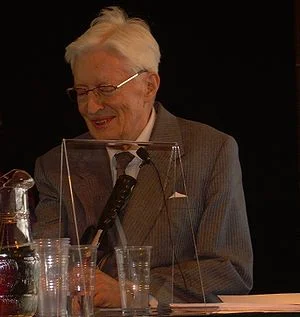
Lassi Nummi (born 1928) considers himself a prose-writer who has strayed into poetry. In a career spanning almost half a century and 25 collections of poetry, his preoccupations, and his central metaphors, have remained constant: landscape, trees, bushes, blades of grass. Interview by Tarja Roinila; poems translated by Herbert Lomas and Anselm Hollo 'During my "social period" I was on the board of the Writers' Union, and its chairman from 1969 to 1972; after that I worked for the Uusi Suomi newspaper and for the PEN Club, whose chairman I was from 1983 to 1988. I was a member of the Bible translation committee for the entire period of its existence, 17 years. A completely different choice would have been to become either a Buddhist or a Christian monk, or then to be a really convinced down-and-out- that might have been the most elegant solution. One could have regulated one's liquid intake, but the freedom of movement would have been pleasant. At the moment I am working out how much...
2 poezii, 0 proze
G.K. Chesterton
Gilbert Keith Chesterton was born in London, England on the 29th of May, 1874. Though he considered himself a mere \"rollicking journalist,\" he was actually a prolific and gifted writer in virtually every area of literature. A man of strong opinions and enormously talented at defending them, his exuberant personality nevertheless allowed him to maintain warm friendships with people-- such as George Bernard Shaw and H. G. Wells--with whom he vehemently disagreed. Chesterton had no difficulty standing up for what he believed. He was one of the few journalists to oppose the Boer War. His 1922 Eugenics and Other Evils attacked what was at that time the most progressive of all ideas, the idea that the human race could and should breed a superior version of itself. In the Nazi experience, history demonstrated the wisdom of his once \"reactionary\" views. His poetry runs the gamut from the comic The Logical Vegetarian to dark and serious ballads. During the dark days of 1940, when Britain...
2 poezii, 0 proze
 JC
JCJean Chevalier
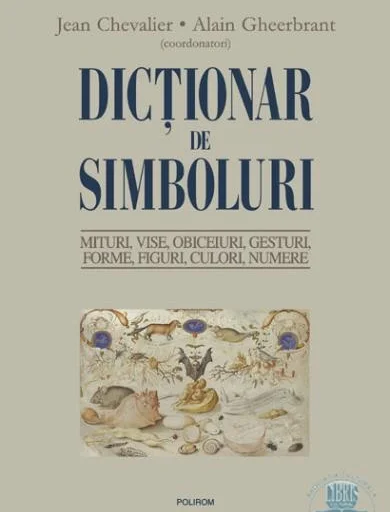
Jean Chevalier (1906-1993) was a university lecturer in philosophy and theology before working for UNESCO, where he was Director of Relations for Member States. He left in 1964 to devote himself to writing and research. He published many works on topics such as St Augustine, Descartes, African religion, Sufism, human spirituality and transcendental meditation. Jean Chevalier is the author of The Penguin Dictionary of Symbols (Dictionary, Penguin), and has 7 books that have been rated 70 times on Goodreads. Intr-o epoca in care imaginatia este revalorificata ca resort al descoperirilor si progresului, dictionarul coordonat de Jean Chevalier si Alain Gheerbrant ilustreaza varietatea cheilor de interpretare – oficiale si subversive, analitice si emotionale, spirituale si sexuale – oferite in diferite culturi simbolurilor fundamentale ale omenirii. Cu informatii din cele mai diverse domenii, de la teologie si astrologie la psihanaliza sau publicitate, si avind la baza surse folclorice,...
2 poezii, 0 proze
 JT
JTJan Twardowski
Jan Jakub Twardowski (June 1, 1915 – January 18, 2006) was a famous Polish poet, but, as he said of himself, he was a priest (of the Catholic Church) first of all. He was a chief Polish representative of contemporary religious lyrics. He wrote short, simple poems, humorous, sometimes with colloquialisms. He joins observation of nature with philosophical reflexion. Twardowski received many awards and medals for his output. Jan Twardowski was born on June 1, 1915 in Warsaw, Congress Poland, Russian Empire as a son of Jan Twardowski and Aniela Maria Konderska. Several weeks later his family was forced to move to Russia (it was World War I). After 3 years the family moved back to Warsaw. In 1927, after finishing a primary school, he started his education in mathematical and environmental gymnasium. He finished it in 1935. In 1932 he began working with the gymnasium youth newspaper called KuŸnia M³odych. He had his own column there, he wrote poems, short stories, interviews with writers,...
1 poezii, 0 proze
 NP
NPNicanor Parra
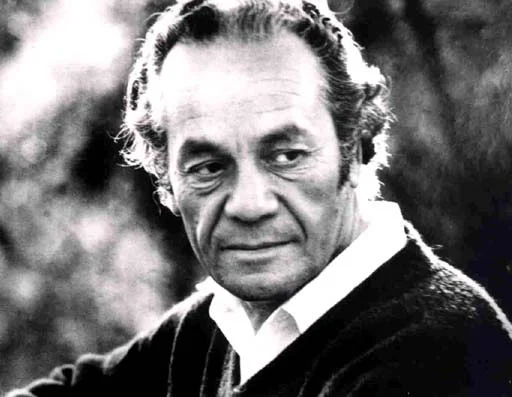
Nicanor Parra Sandoval (born in San Fabián de Alico, Chile on September 5, 1914) is a mathematician and poet often considered to be the most influential poet Chile has produced since Pablo Neruda.[citation needed] He describes himself as an "antipoet," due to his distaste for standard poetic pomp and function (after recitations he would exclaim Me retracto de todo lo dicho, or, "I take back everything I said"). Trying to get away from the conventions of poetry, Parra's poetic language renounces the refinement of most Latin American literature and adopts a more colloquial tone similar to prose. His first collection, "Poemas y Antipoemas" (1954) is a classic of Latin American literature, one of the most influential Spanish poetry collections of the twentieth century, and is cited as an inspiration by American Beat Writers such as Allen Ginsberg. Parra has been nominated several times for the Nobel Prize in Literature. Parra comes from the artistically prolific Chilean Parra family of...
2 poezii, 0 proze
 MG
MGMaxim Gorki
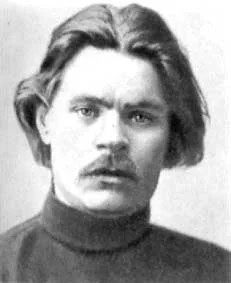
[[en]] * Born: 16 March 1868 * Birthplace: Nizhny Novgorod (now Gorky), Russia * Death: June 1936 * Best Known As: Russian writer known for his socialist realism Name at birth: Aleksey Maksimovich Peshkov Maxim Gorky (also spelled Maksim Gorki) is one of the giants of 20th century Russian literature and theater, known for his realistic depictions of how terrible it is to be poor and oppressed. Gorky himself grew up in rough times and was a lifelong spokesperson for the underclass. His political activism led to several years of exile, in spite of his popularity with Russian readers. By 1900 Gorky was a famous literary figure, thanks in part to help from Anton Chekhov. His short stories and his first novel, Foma Gordeyev (1902) gave him notoriety as well as critical success, but his outspoken opposition to the rule of Nicholas II led to his exile to the island of Capri (1907-13). After the 1917 revolution Gorky's criticism of his friend V. I. Lenin and the Bolsheviks led to another...
2 poezii, 0 proze
Jim Morrison
The facts are very simple. So simple that they might mislead you into thinking that the young man whose picture you see on this page is- well, a lot like a lot of other young men. But he isn`t. His full real name is James Douglas Morrison. He was born on December 8, 1943, in Melbourne, Fla.- which is near Cape Kennedy. Jim is six feet tall and has brown hair and haunting blue-grey eyes. After attending Florida State University, he moved to California, where he studied film-making at UCLA. Fortunately, he was side-tracked into the world of music (which had always held great interest for him) and he soon found himself the lead singer of a group called the Doors.
44 poezii, 0 proze
 JS
JSJaime Sabines
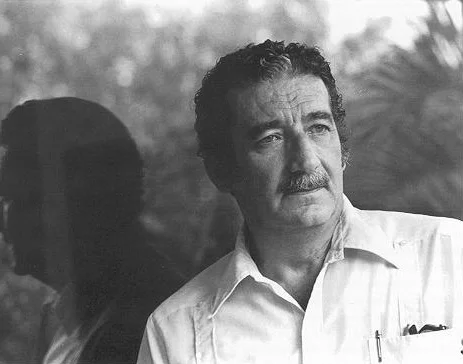
Jaime Sabines Gutiérrez (March 25, 1926 - March 19, 1999) is arguably Mexico's most influential contemporary poet. Known as “the sniper of Literature” as he formed part of a group that transformed literature into reality, he wrote ten volumes of poetry, and his work has been translated into more than twelve languages. His writings chronicle the experience of everyday people in places such as the street, hospital, and playground. Sabines was also a politician. Jaime Sabines was born on March 25, 1926 in Tuxtla Gutiérrez, Chiapas. Before he devoted himself to the study of literature, he spent three years studying medicine before moving on to his real vocation: Spanish and literature, studying at the Universidad Nacional Autónoma de México (UNAM), and obtaining a postgraduate degree. Sabines was an outstanding student at the Mexican Writers Centre from 1964 to 1965 and part of the jury for the Casa de las Americas prize. In addition to his literary activity, he participated in politics...
8 poezii, 0 proze
Kurt Weill
Biography Early Years Kurt Weill was born on 2 March 1900 in Dessau, Germany. The son of a cantor, Weill displayed musical talent early on. By the time he was twelve, he was composing and mounting concerts and dramatic works in the hall above his family\'s quarters in the Gemeindehaus. During the First World War, the teenage Weill was conscripted as a substitute accompanist at the Dessau Court Theater. After studying theory and composition with Albert Bing, Kapellmeister of the Theater, Weill enrolled at the Berlin Hochschule für Musik, but found the conservative training and the infrequent lessons with Engelbert Humperdinck too stifling. After a season as conductor of the newly formed municipal theater in Lüdenscheid, he returned to Berlin and was accepted into Ferruccio Busoni\'s master class in composition. He supported himself through a wide range of musical occupations, from playing organ in a synagogue to piano in a Bierkeller, by tutoring students (including Claudio Arrau and...
1 poezii, 0 proze
himself...
de ioana matei
zadarnic deasupra lui este cerul!...
To Himself
de Giacomo Leopardi
Now will you rest forever, My tired heart. Dead is the last deception, That I thought eternal. Dead. Well I feel In us the sweet illusions, Nothing but ash, desire burned out. Rest forever. You have...
Forme minimaliste. <i>Spre un teatru sărac</i> cu Jerzy Grotowski
de Ioana Petcu
himself Cum Figuris Scena poloneză ar fi putut rămîne amorțită (și nu pentru că n-ar fi avut actori sau regizori de excelență), dacă Jerzy Grotowski (1922-1999) nu ar fi fost. Nu doar activitatea sa...
testamentele din mijloacele de transport in comun
de Andrei Gheorghe
testamentele din mijloacele de transport în comun a man himself întotdeauna agramat și imponderabil se îndrepta către casă în metrou bărbia i se coborâse cu două stații în urmă în piept și fesul îi...
Mediamorfoze - 1
de Sebastian Corneanu
Mediaidentitate Mă numesc Sebastian, sebastian_himself, sebacc2005, sebastianxxx, sebastian4u sau nu contează cum. Am orice nume sau toate numele, iar toate sunt ale mele, atâta vreme cât nu sunt ale...
Cîntec – Fotografia Number One
de Lucia Daramus
Lucia Daramus Cîntec – Fotografia Number One A dwarf standing on the shoulders of a giant may see farther than the giant himself spunea cîndva o zînă ce-și făcuse casa de alabastru la numărul șase...
Albert Einstein\'s Words on Spirituality and Religion
de Albert Einstein
(The following quotes are taken from The Quotable Einstein, Princeton University Press unless otherwise noted) \"My religion consists of a humble admiration of the illimitable superior spirit who...
Sonnet XLVII
de William Shakespeare
Betwixt mine eye and heart a league is took, And each doth good turns now unto the other: When that mine eye is famish\'d for a look, Or heart in love with sighs himself doth smother, With my love\'s...
Ultimul capitol
de Florin DeRoxas
De Roxas combines a poetic feel for cadence, rhyme and rhythm to create a romantic and sensitive exploration of love’s many facets. Heartfelt sentiments permit readers to peer deeply into...
Summa Theologica
de Thomas Aquinas
fragment.. Objection 1. It seems that there are no ideas. For Dionysius says (Div. Nom. vii), that God does not know things by ideas. But ideas are for nothing else except that things may be known...