
"Women-Like Words" – 546 rezultate
0.03 secundeMeilisearch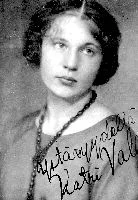 KV
KVKatri Vala
( 1901 – 1944 ) One of the Finnish poets who brought a free verse style of writing poetry into the mainstream of Finnish literature. Her work is full of the ecstasy of life, longing for distant places, and a use of vocabulary glutted in color, into which are woven a general radical quality, which affects her late works especially. She is considered a late proponent of the ideals of the Carriers of the Flame. Her earlier works show her dedicated to light and its power. Her output is not extensive. Mention should be made of: Kaukainen puutarha (The Distant Garden) (1924) Sininen ovi (The Blue Door) (1926) Maan laiturilla (On the Land Wharf) (1930) In some later works, there is a more serious, darker tone, represented by: Paluu (The Return) (1934) Pesäpuu palaa (The Nest Tree Burns) (1942) Her life’s program was: Oh! If life could be better than death! Katri Vala died of tuberculosis at the end of WW II, while under treatment in Sweden. Even so, her poetry remained more life-positive...
1 poezii, 0 proze
 LS
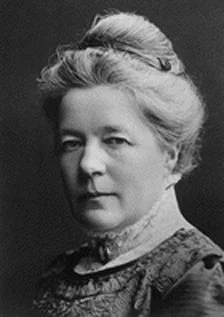
LSLagerlof Selma
[[eng]] born Nov. 20, 1858, Mårbacka, Swed. died March 16, 1940, Mårbacka Swedish novelist. She was working as a schoolmistress when she wrote her first novel, Gösta Berlings saga (1891), a chronicle of life in her native Värmland. Later works include Jerusalem (1901–02), which established her as Sweden's foremost novelist, and The Wonderful Adventures of Nils and its sequel (1906–07), a geography reader for children in fantasy form. A naturally gifted storyteller, she rooted her work in legend and saga. In 1909 she became the first woman and the first Swedish writer to win the Nobel Prize for Literature. [[/eng]]
1 poezii, 0 proze
 YA
YAYosano Akiko
Akiko Yosano, 7 December 1878 - 29 May 1942) was the pen-name of a Japanese author, poet, pioneering feminist, pacifist, and social reformer, active in late Meiji period, Taishō period and early Showa period Japan. Her real name was Yosano Shiyo. She is one of the most famous, and most controversial, post-classical woman poets of Japan. Yosano was born the daughter of a rich merchant in Sakai, Osaka. From early childhood, she was fond of reading literary works while she helped her family business. When she was a high school student, she began to subscribe to the poetry magazine Myōjō (Bright Star), and she became one of its most important contributors. Myōjō’s editor, Yosano Tekkan, taught her tanka poetry and sometimes visited her in Sakai. Although Tekkan was married, the two authors fell in love and started a new life together in the suburb of Tokyo. Tekkan eventually divorced his wife and married Akiko in 1901. In 1901, Yosano brought out her first volume...
1 poezii, 0 proze
 JT
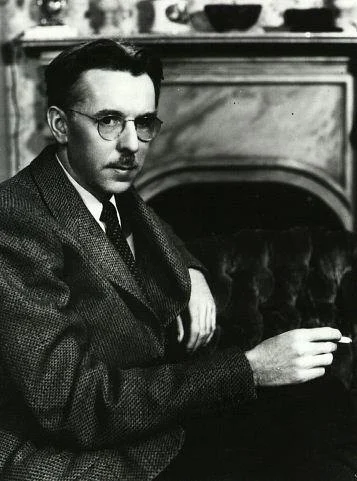
JTJames Thurber
Born: 8 December 1894 Birthplace: Columbus, Ohio Death: 2 November 1961 (complications from a stroke) Best Known As: Author of The Secret Life of Walter Mitty Thurber\'s witty short stories and lumpy cartoons were a popular mainstay of The New Yorker magazine in the 1930s and 1940s. A Midwestern boy with an urbane twist, Thurber mixed comical reminiscences of his Ohio childhood with wry observations on modern times and the battle of the sexes. (His best-known story is The Secret Life of Walter Mitty, the tale of a henpecked husband who escapes into heroic daydreams.) Thurber\'s funny, loopy, absurdist cartoons featured men, women, dogs and other strange animals. He was by turns hilarious and melancholy, and his darker nature seemed to come out in stories and cartoons about husbands and wives: the wives often domineering and sarcastic, the husbands harried or bitterly triumphant. Like Mark Twain, Thurber became increasingly morose in his last decade, although he continued to write...
1 poezii, 0 proze
 CR
CRChristina Rossetti
Christina Georgina Rossetti, one of the most important women poets writing in nineteenth-century England, was born in London December 5, 1830, to Gabriele and Frances (Polidori) Rossetti. Although her fundamentally religious temperament was closer to her mother\'s, this youngest member of a remarkable family of poets, artists, and critics inherited many of her artistic tendencies from her father. Judging from somewhat idealized sketches made by her brother Dante, Christina as a teenager seems to have been quite attractive if not beautiful. In 1848 she became engaged to James Collinson, one of the minor Pre-Raphaelite brethren, but the engagement ended after he reverted to Roman Catholicism. When Professor Rossetti\'s failing health and eyesight forced him into retirement in 1853, Christina and her mother attempted to support the family by starting a day school, but had to give it up after a year or so. Thereafter she led a very retiring life, interrupted by a recurring illness which...
8 poezii, 0 proze
 SB
SBSimone de Beauvoir
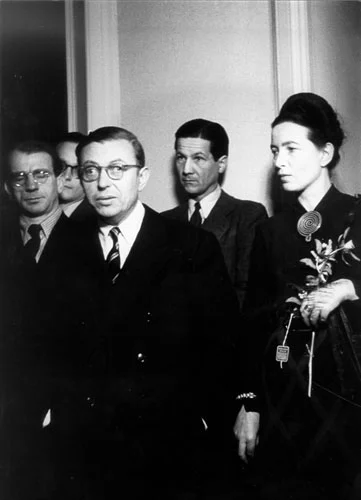
French Existentialist, Writer, and Social Essayist Born and educated in Paris, Simone de Beauvoir was among the first women permitted to complete a program of study at the École Normale Supérieure. Through her lifelong friendship with Sartre, she contributed significantly to the development and expression of existentialist philosophy. Jean-Paul Sartre and De beauvoir met after her studies in the Sorbonne, the beginning of a friendship which lasted until his death in 1980. This period began what she described as a \'moral\' phase of life; the culmination of which was her most important philosophical work, The Ethics of Ambiguity(1948). She began the phase with an essay entitled Pyrrhus et Cineas(1944), and the earlier novel called L\'Envitee(1943). No doubt born of the confusion and madness of WWII, De Beauvoir included in her Ethics Sartre\'s ontology of being-for-itself and being-in-itself. She also draws heavily on his conception of human beings as creatures who are free. Freedom of...
2 poezii, 0 proze
 ES
ESElse Lasker- Schuler
born Feb. 11, 1869, Elberfeld, Ger. died Jan. 22, 1945, Jerusalem, Palestine Else Lasker-Schüler (February 11, 1869 – January 22, 1945) was a Jewish German poet and playwright (1869-1945) famous for her bohemian lifestyle in Berlin. She was one of the few women affiliated with the Expressionist movement. Lasker-Schüler fled Nazi Germany and lived out the rest of her life in Jerusalem Schüler was born in Elberfeld, now a district of Wuppertal. Her mother, Jeannette Schüler (née Kissing) was a central figure in her poetry, and the main character of her play Die Wupper was inspired by her father, Aaron Schüler, a Jewish banker. In 1894, Else married the physician and occasional chess player, Jonathan Berthold Lasker (the older brother of Emanuel Lasker, a World Chess Champion) and moved with him to Berlin, where she trained as an artist. On August 24, 1899 her son Paul was born and her first poems were published. She published her first full volume of poetry, Styx, three years later, in...
2 poezii, 0 proze
 AW
AWAlice Walker
Alice Walker is an American novelist, short-story writer, poet, essayist, and activist. Her most famous novel, The Color Purple, was awarded the Pulitzer Prize and the National Book Award in 1983. Alice Walker\'s creative vision is rooted in the economic hardship, racial terrorism, and folk wisdom of African American life and culture, particularly in the rural South. Her writing explores multidimensional kinships among women, among men and women, among humans and animals and embraces the redemptive power of social, spiritual and political revolution.
1 poezii, 0 proze
 EM
EMEdna St. Vincent Millay
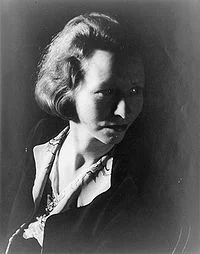
Edna St. Vincent Millay (February 22, 1892 – October 19, 1950) was an American lyrical poet and playwright and the first woman to receive the Pulitzer Prize for Poetry. She was also known for her unconventional, bohemian lifestyle and her many love affairs. She used the pseudonym Nancy Boyd for her prose work. Millay was born in Rockland, Maine to Cora Lounella, a nurse, and Henry Tollman Millay, a schoolteacher who would later become superintendent of schools. Her middle name derives from St. Vincent's Hospital in New York, where her uncle's life had been saved just prior to her birth. In 1904 Cora officially divorced Millay's father for financial irresponsibility, but they had been separated for some years prior. Struggling financially, Cora and her three daughters — Edna (who would later insist on being called "Vincent"), Norma, and Kathleen — moved from town to town, counting on the kindness of friends and relatives. Though poor, Cora never traveled without her trunk full of...
4 poezii, 0 proze
 MA
MAManuel Acuña
Manuel Acuña Narro (27 August 1849 – 6 December 1873) was a 19th-century Mexican writer. He focused on poetry, but also wrote some novels and plays. Even though he was famous at an early time of his life, he decided to commit suicide. It is not certain why he killed himself, but it is thought that he did so because of a woman. Acuña was born in the city of Saltillo, Coahuila, on August 27, 1849 to Francisco Acuña and Refugio Narro. He was taught how to write and read at an early age. Later he studied in the “Colegio Josefino”, in Saltillo. Around 1865 he was transferred to Mexico City to the School of San Ildefonso, where he entered as a full time student. Here he studied mathematics, Latin, French and philosophy. Acuña lived at a time at which Mexican society was dominated by philosophical-positivist intellectuality. Furthermore he was living as a romantic tendency in poetry was occurring. In January 1868, Acuña initiated his studies in medicine at the...
1 poezii, 0 proze
De Padre Vostro
de A. Robert Mario
It was a long time ago... When ? i can’t remember It was in a time when Kings never surrender In times of Knights,only the bloody moon knows theyr story When mountains and rivers were moved by love,...
The Poems of Sappho, Part III
de Sappho
The Poems of Sappho, Part III 44 Ge\'llws paidofilwte\'ra. More fond of children than Gello. Zenobius, about A.D. 130, quotes this as a proverb. The ghost of Gello was said by the Lesbians to pursue...
Interview with Enrique Iglesias
de A.M. Rika
Enrique Iglesias reaches for the stars with his feet on the ground Enrique Iglesias is the boy next door, someone who grew up doing things quietly, but effectively. Dreaming of becoming a pop star...
The Poems of Sappho, Part IV
de Sappho
The Poems of Sappho, Part IV 110 H?mitu\'bion stala\'sson. A napkin dripping. From the Scholiast on the Plutus of Aristophanes to show the meaning of h?mitu\'bion. This was a piece of soft linen for...
Albert Einstein\'s Words on Spirituality and Religion
de Albert Einstein
(The following quotes are taken from The Quotable Einstein, Princeton University Press unless otherwise noted) \"My religion consists of a humble admiration of the illimitable superior spirit who...
Ghost
de Alin Niculae
\"...and my soul from out that shadow that lies floating on the floor shall be lifted Nevermore.\" on a sweet scented summer day with the ashes falling from the sky the ashes he once loved for they...
Necronomikon
de Abdul al-Hazred
THE TESTIMONY OF MAD ARAB THIS is the testimony of all that I have seen, and all that I have learned, in those years that I have possesed the Three Seals of MASSHU. I have seen One Thousand and-One...
I always say
de Lia Miruna Dumitrache
So there we were, in hell. Burning programme’s nine to four – the perpetual thing is bogus cause there’s too many of us and they have to have shifts and besides they gotta cool the place down at...
DEMOCRACY
de Leonard Cohen
It’s coming through a hole in the air From those nights in Tianamen Square It’s coming from the feel That is ain’t exactly real Or it’s real, but ain’t exactly there. From the wars against disorder,...
Dracula
de Bram Stoker
Chapter 21 - Dr. Seward\'s Diary 3 October. Let me put down with exactness all that happened, as well as I can remember it, since last I made an entry. Not a detail that I can recall must be...