
"The rules" – 11463 rezultate
0.02 secundeMeilisearch JA
JAJohn Ashbery
John Ashbery (born July 28, 1927) is an American poet. He has won nearly every major American award for poetry and is recognized as one of America's most important, though still controversial, poets. In an article on Elizabeth Bishop in his Selected Prose, he characterizes himself as having been described as "a harebrained, homegrown surrealist whose poetry defies even the rules and logic of Surrealism." "No figure looms so large in American poetry over the past 50 years as John Ashbery", Langdon Hammer, chairman of the English Department at Yale University, wrote in 2008. American poet has had a larger, more diverse vocabulary, not Whitman, not Pound". Stephen Burt, a poet and Harvard professor of English has compared Ashbery to T. S. Eliot, the "last figure whom half the English-language poets alive thought a great model, and the other half thought incomprehensible" Ashbery was born in Rochester, New York, and raised on a farm near Lake Ontario; his brother died when they were...
4 poezii, 0 proze
Carla Ionita
I am the damnedest creature! I make you think of the old story about Alexander the Great. He wept when there were no more worlds to conquerr. Will I weep when there are no more rules to break?
2 poezii, 0 proze
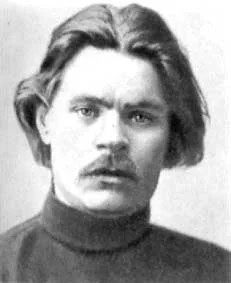 MG
MGMaxim Gorki
[[en]] * Born: 16 March 1868 * Birthplace: Nizhny Novgorod (now Gorky), Russia * Death: June 1936 * Best Known As: Russian writer known for his socialist realism Name at birth: Aleksey Maksimovich Peshkov Maxim Gorky (also spelled Maksim Gorki) is one of the giants of 20th century Russian literature and theater, known for his realistic depictions of how terrible it is to be poor and oppressed. Gorky himself grew up in rough times and was a lifelong spokesperson for the underclass. His political activism led to several years of exile, in spite of his popularity with Russian readers. By 1900 Gorky was a famous literary figure, thanks in part to help from Anton Chekhov. His short stories and his first novel, Foma Gordeyev (1902) gave him notoriety as well as critical success, but his outspoken opposition to the rule of Nicholas II led to his exile to the island of Capri (1907-13). After the 1917 revolution Gorky's criticism of his friend V. I. Lenin and the Bolsheviks led to another...
2 poezii, 0 proze
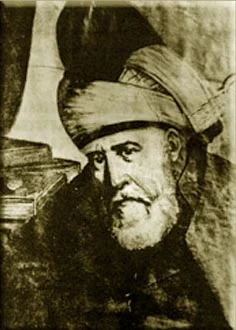 MR
MRMevlana Jalaluddin Rumi
Mawlānā Jalāl ad-Dīn Muḥammad Balkhī, also known as Jalāl ad-Dīn Muḥammad Rūmī, but known to the English-speaking world simply as Rumi, (30 September 1207 – 17 December 1273), was a 13th-century Persian poet, Islamic jurist, theologian, and mystic. Rūmī is a descriptive name meaning "the Roman" since he lived most of his life in an area called Rūm because it was once ruled by the Byzantine Empire. According to tradition, Rumi was born in Balkh, Khorasan (now in Afghanistan), the hometown of his father's family. Scholars, however, argue that he was most likely born in Wakhsh, a small town located at the river Wakhsh in what is now Tajikistan. Wakhsh belonged to the larger province of Balkh, and in the year Rumi was born, his father was an appointed scholar there. Both these cities were at the time included in the Greater Persian cultural sphere of Khorasan, the easternmost province of historical Persia, and were...
162 poezii, 0 proze
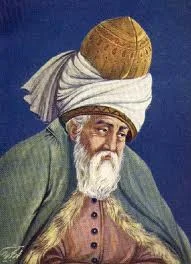 JR
JRJalal ad-Dīn Muhammad Rumi
Jalāl ad-Dīn Muḥammad Balkhī, also known as Jalāl ad-Dīn Muḥammad Rūmī, and popularly known as Mowlānā but known to the English-speaking world simply as Rumi (30 September 1207 – 17 December 1273), was a 13th-century Persian (Tajik) Muslim poet, jurist, theologian, and Sufi mystic. Rūmī is a descriptive name meaning "the Roman" since he lived most of his life in an area called Rūm because it was once ruled by the Eastern Roman Empire. It is likely that he was born in the village of Wakhsh, a small town located at the river Wakhsh in what is now Tajikistan. Wakhsh belonged to the larger province of Balkh, and in the year Rumi was born, his father was an appointed scholar there. Both these cities were at the time included in the greater Persian cultural sphere of Khorasan, the easternmost province of Persia, and were part of the Khwarezmian Empire. Image of the Rumi on an old book in the Mevlâna museum; Konya,...
0 poezii, 0 proze
Hancu George
Inspiration Inspiration Sit down she said, pen me a few lines, tell me of life, love, hopes and dreams. write to me of much happier times When love ruled your heart, and life it seemed Was full of possibilities, plans and endless schemes. I took up the challenge, and began to write, Of life, of love and hopes and dreams, Words flowed like rivers, as I wrote them down, Thinking all the while of the lady I'd found To inspire my thoughts, and urge me on, To make something beautiful, maybe a song. Into the small hours, I toiled away, writing down lines, throwing them away. 'Twas then that I realised, that the happier times That she spoke of and wanted, were not of that time. For the happier times were not from long ago, But were here with me now, and now I know, That 'twas the love for this lady, that made my words flow, And to write something beautiful, for her, her alone. I wrote of life, and my living with her, Of love, her in my arms forever more, Of hopes, a future for us so bright,...
2 poezii, 0 proze
 A
AAnvari
Anvari (1126–1189), full name Awhad ad-Din 'Ali ibn Mohammad Khavarani or Awhad ad-Din 'Ali ibn Mahmud was one of the greatest Persian poets. He was born in Abivard of (now in Turkmenistan) and died in Khurasanian Balkh, now in Afghanistan, and studied science and literature at the collegiate institute in Tun (now Firdaus, Iran), becoming a famous astronomer as well as a poet. Anvari's poems were collected in a Deewan, and contains panegyrics, eulogies, satire, and others. His elegy "Tears of Khorasan", translated into English in 1789, is considered to be one of the most beautiful poems in Persian literature. The Cambridge History of Iran calls Anvari "one of the greatest figures in Persian literature". Despite their beauty, his poems often required much help with interpretation, as they were often complex and difficult to understand. Anvari's panegyric in honour of the Seljuk sultan Sultan Sanjar (1117–1157), ruler of Khorasan, won him royal favour, and allowed him to go on to enjoy...
2 poezii, 0 proze
 MS
MSMellin de Saint-Gelais
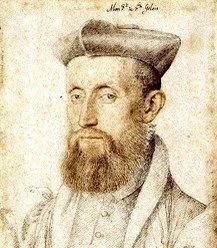
Mellin de Saint-Gelais (1490-1558), poet francez renascentist. *** Mellin de Saint-Gelais (or Melin de Saint-Gelays or Sainct-Gelais; c. 1491 – October, 1558) was a French poet of the Renaissance and Poet Laureate of Francis I of France. He was born at Angoulême, most likely the natural son of Jean de Saint-Gelais, marquis de Montlieu, a member of the Angoumois gentry. His forename was the French-Norman malapropism of the British wizard Merlin featured in Arthurian legends. He was close to his uncle Octavien de Saint-Gelais (1466-1502), bishop of Angoulême since 1494, himself a poet who had translated the Aeneid into French. Mellin, who had studied at Bologna and Padua, had the reputation of being doctor, astrologer and musician as well as poet. He returned to France around 1523, and soon gained favour at the court of the art-loving Valois ruler Francis I by his skill in light verse. He was made almoner to the Dauphin, abbot of Reclus in the diocese of Troyes and librarian...
1 poezii, 0 proze
the crow
un spectru bantuie Europa
4 poezii, 0 proze
 TJ
TJThe Rave parties going Jester
nu stiu cum naiba sa scap de contul asta infect
2 poezii, 0 proze
Is the first day of the rest of your life
de Traian Rotărescu
Presupunând existența îngerilor, Ei s-ar uita la videoclipurile preferate? Sigur, dacă videoclipurile ar intra in sfera procupărilor lor. Oameni...femei. Femei...oameni. Sex, love...durex, nume,...
tonight is the night
de shole
drunk too much grass too many pills I will always remember to love you tomorrow your white dress your words your touch and your smile how come I failed when I followed all the rules will we ever meet...
The Apocalyptic Subculture of a Woman\'s Man
de Ohm
Where can I begin? Where will it end? Well, either in the year 2003 or the year 2006, most likely the latter. The remaining timeline grows thinner as the world grows fatter. It doesn\'t matter,...
playing God
de Alina
An introduction to what I’m saying now..? `I’ve missed you` , it’s probably the closest to my feelings and then ..,there’s this picture (from which you , very convenient , cut out somebody ‘ s face )...
life teachings
de Cristina
1.Give others more than they expect you to give and do this with joy. 2.Learn by heart your favorite poem. 3.Don’t believe all you here, don’t spent all you have and don’t sleep as much as you want....
Reguli pentru a scrie haiku
de Corneliu Traian Atanasiu
Regulile de mai jos se referă la un haiku mai liberalizat, la cel care e practicat în lumea anglo-saxonă. Unele sînt în opoziție cu cele ale haiku-ului clasic, dar o oarecare relaxare există și în...
A lung-full
de Dragos
The drops of rain sparkle ruby and turn to blood falling down my chest, on my face, onto dirt. The same soul that once hated the eerie storm now drops down in the puddle of blood in ecstasy blending...
Rengay - cel mai simplu poem în lanț
de Corneliu Traian Atanasiu
Doi autori de poeme în lanț: Steve Mason (left) and Martin Lucas in full \'rengay\' mode (pentru că nu am găsit o imagine cu Gary Gay). Rengay este un poem în lanț inventat de poetul american Gary...
Culoarea din noi
de RAPCEA ROMULUS
Ce-ar fi, omule, să-ți privești întâi sufletul, Nu pielea altuia, ci lumina din ochiul lui? Căci lumea-i un câmp de flori, toate diferite, Dar împreună fac primăvara desăvârșită. De ce judeci tu un...
The Discourse of History
de Roland Barthes
The formal description of sets of words beyond the level of the sentence (what we call for convenience discourse) is not a modern development: from Gorgias to the nineteenth century, it was the...