
"It was a time of triumph for the morons" – 4371 rezultate
0.03 secundeMeilisearch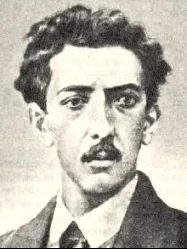 MA
MAManuel Acuña
Manuel Acuña Narro (27 August 1849 – 6 December 1873) was a 19th-century Mexican writer. He focused on poetry, but also wrote some novels and plays. Even though he was famous at an early time of his life, he decided to commit suicide. It is not certain why he killed himself, but it is thought that he did so because of a woman. Acuña was born in the city of Saltillo, Coahuila, on August 27, 1849 to Francisco Acuña and Refugio Narro. He was taught how to write and read at an early age. Later he studied in the “Colegio Josefino”, in Saltillo. Around 1865 he was transferred to Mexico City to the School of San Ildefonso, where he entered as a full time student. Here he studied mathematics, Latin, French and philosophy. Acuña lived at a time at which Mexican society was dominated by philosophical-positivist intellectuality. Furthermore he was living as a romantic tendency in poetry was occurring. In January 1868, Acuña initiated his studies in medicine at the...
1 poezii, 0 proze
 HF
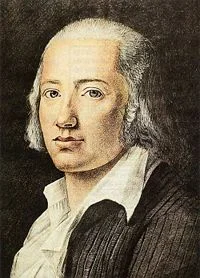
HFHÖLDERLIN, Friedrich
Johann Christian Friedrich Hölderlin (20 March 1770 – 6 June 1843) was a major German lyric poet. His work bridges the Classical and Romantic schools. Having spent most of his life tormented by mental illness, he suffered great loneliness, and often spent his time playing the piano, drawing, reading, writing, and enjoyed travelling when he had the chance. The poetry of Hölderlin, widely recognized today as one of the highest points of German literature, was little known or understood during his lifetime and slipped into obscurity shortly after his death; his illness and reclusion made him fade from his contemporaries' consciousness – and, even though selections of his work were being published by his friends already during his lifetime, it was largely ignored for the rest of the 19th century. In fact, Hölderlin was a man of his time, an early supporter of the French Revolution – in his youth at the Seminary of Tübingen, he and some colleagues from a "republican club" planted a "Tree...
22 poezii, 0 proze
James Joyce
Joyce was born in Dublin, where his father was a rates collector. He was educated at a Jesuit school and University College, Dublin where he studied philosophy and language. When he was still an undergraduate, in 1900, his long review of Ibsen’s last play was published in the Fortnightly Review. At this time he also began writing his poems which were later collected in Chamber Music, published in 1907. In 1902 Joyce left Dublin for Paris, but returned the following year as his mother was dying. From 1904 he lived with Nora Barnacle, whom he married in 1931 (the year his father died), a son was born in 1905, and a daughter in 1918. Their home from 1905 to 1915 was Trieste, where Joyce taught English at the Berlitz school. In 1909 and 1912 he made his final trips to Ireland, attempting to arrange the publication of his first book Dubliners, which finally appeared in England in 1914. It was during this time that he was contacted by Ezra Pound, a leading champion of modernist writers who...
0 poezii, 0 proze
Robert Browning
Robert Browning was born on May 7, 1812 in Camberwell, which is south of London. His birthday falls within a couple of months of the births of Dickens and Thackeray. He was the eldest of 2 children, born to Robert and Sarah Anna Browning. His father was a bank clerk. He attended London University for a short while in 1828, but received most of his education by readinghis from his father\'s library. His first poem, Pauline, was published when he was 21. It was soon followed by Paracelsus (1835) and Sordello (1840). A year later, Pippa Passes, the first in a series entitled Bells and Pomegranates was published; the remaining seven parts appeared between 1841-46. In 1846, Browning eloped with Elizabeth Barrett and lived with her in Italy until his death in 1861. Various difficulties made the poet\'s requested burial in Florence impossible, and his body was returned to England to be interred in Westminster Abbey. The they left you for their pleasure: till in due time, one by one, Some...
12 poezii, 0 proze
 MR
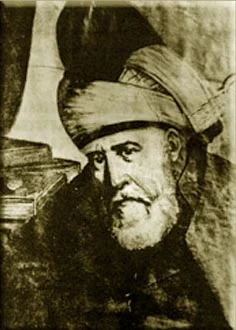
MRMevlana Jalaluddin Rumi
Mawlānā Jalāl ad-Dīn Muḥammad Balkhī, also known as Jalāl ad-Dīn Muḥammad Rūmī, but known to the English-speaking world simply as Rumi, (30 September 1207 – 17 December 1273), was a 13th-century Persian poet, Islamic jurist, theologian, and mystic. Rūmī is a descriptive name meaning "the Roman" since he lived most of his life in an area called Rūm because it was once ruled by the Byzantine Empire. According to tradition, Rumi was born in Balkh, Khorasan (now in Afghanistan), the hometown of his father's family. Scholars, however, argue that he was most likely born in Wakhsh, a small town located at the river Wakhsh in what is now Tajikistan. Wakhsh belonged to the larger province of Balkh, and in the year Rumi was born, his father was an appointed scholar there. Both these cities were at the time included in the Greater Persian cultural sphere of Khorasan, the easternmost province of historical Persia, and were...
162 poezii, 0 proze
 JR
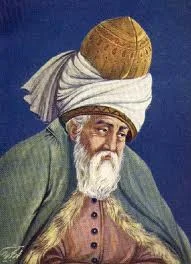
JRJalal ad-Dīn Muhammad Rumi
Jalāl ad-Dīn Muḥammad Balkhī, also known as Jalāl ad-Dīn Muḥammad Rūmī, and popularly known as Mowlānā but known to the English-speaking world simply as Rumi (30 September 1207 – 17 December 1273), was a 13th-century Persian (Tajik) Muslim poet, jurist, theologian, and Sufi mystic. Rūmī is a descriptive name meaning "the Roman" since he lived most of his life in an area called Rūm because it was once ruled by the Eastern Roman Empire. It is likely that he was born in the village of Wakhsh, a small town located at the river Wakhsh in what is now Tajikistan. Wakhsh belonged to the larger province of Balkh, and in the year Rumi was born, his father was an appointed scholar there. Both these cities were at the time included in the greater Persian cultural sphere of Khorasan, the easternmost province of Persia, and were part of the Khwarezmian Empire. Image of the Rumi on an old book in the Mevlâna museum; Konya,...
0 poezii, 0 proze
Radu Contes
The beginning of my childhood was profoundly marked by one of my grandfather’s passions – literature. For him reading, living, the writings of so many did not seem to be enough, so he began writing his own stories that still echo in my memory and in my heart. I remember that one day I went to him and asked “What are you writing about?”. Looking at me for only a second and returning his eyes at the ink stained notebook he answered: “My life”. Regretful, I confess that that was the last dialogue we had. After that I began reading, reading everything he was writing. Two years after his death, I had met someone who changed everything. I stopped reading and began writing myself. It was such a new feeling. It seemed to be never ending. It still feels. Since the first time, you may think I am exaggerating, but it really was the first time I saw her when I felt this sudden urge of writing. Words like “Thank you” seem meaningless compared to the things that you have done for me.
2 poezii, 0 proze
 JK
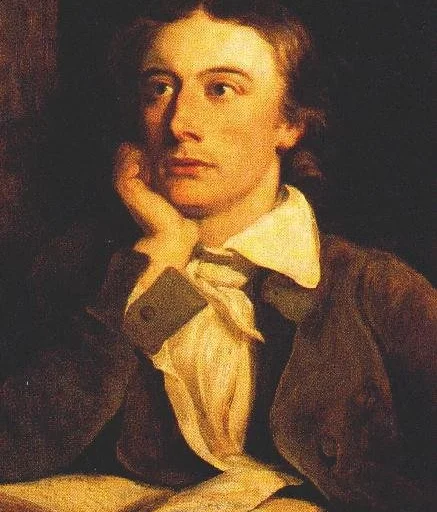
JKJohn Keats
John Keats was born on 31 October 1795 (probably), first child of Thomas Keats and Frances Jennings Keats, who had apparently eloped1. Everything was pretty ordinary for all concerned for a while--the Keatses had three more sons (George and Thomas, plus Edward who died as a baby) and one daughter, Frances, by 1803. That was also the year when John went away to school at Enfield. In 1804, John\'s father was killed in a fall from a horse. Just over two months later, for mysterious reasons, Frances remarried, to a London bank clerk named William Rawlings. Frances quickly decided she\'d made some sort of terrible error and left, taking nothing with her since the laws of the time decreed that all her property and even her children belonged to her husband. Frances\' mother, Alice, swept in and took custody of the children, but she could do nothing about the Swan and Hoop, which Rawlings sold immediately before disappearing. It was around this time that John became prone to fistfights, which...
32 poezii, 0 proze
lewis carroll
Lewis Carroll [pseudonym of Charles Lutwidge Dodgson] (1832-1898), English author, mathematician, and Anglican clergyman wrote Alice’s Adventures in Wonderland (1865); Either the well was very deep, or she fell very slowly, for she had plenty of time as she went down to look about her and to wonder what was going to happen next….then she looked at the sides of the well, and noticed that they were filled with cupboards and book-shelves; here and there she saw maps and pictures hung upon pegs. She took down a jar from one of the shelves as she passed; it was labelled ‘ORANGE MARMALADE’, but to her great disappointment it was empty: (Ch. 1) And thus begins Alice’s fantastical adventures that have endured in their popularity for over a century, influencing contemporary authors, artists, musicians and inspiring adaptations to the stage and screen. Carroll’s particular mix of creativity, fantasy, word play, satire, nonsense, and dry wit have gained him iconic status in popular culture with...
6 poezii, 0 proze
Suzanne Nadine Vega
Suzanne Vega was born July 11, 1959, in Santa Monica, CA; her parents divorced shortly thereafter, and after her mother (a jazz guitarist) remarried to Puerto Rican novelist Ed Vega, the family moved to Manhattan. A shy and quiet child, Suzanne nonetheless learned to take care of herself growing up in the tough neighborhoods of Spanish Harlem. Her parents often sang folk songs around the house, and when she began playing the guitar at age 11, she found herself attracted to the poetry of singer/songwriter music (Dylan, Cohen), and found a refuge from New York\'s chaos in traditional folk (Woody Guthrie, Pete Seeger, Judy Collins, Joan Baez). At age 14, she made her first attempts at writing songs; however, when she attended the High School for the Performing Arts as a teenager, it was to study dance, not music. She subsequently enrolled at Barnard College as a literature major, and during this time, she began playing at coffeehouses and folk festivals on the West Side and near Columbia...
1 poezii, 0 proze
It was a time of triumph for the morons
de Alexandru Paleologu
Mr. Paleologu, to begin with, let us say that this talk is the result of certain hostile attitudes, especially in the Western media, concerning Mircea Eliade and what we call here “Generation ’27”. I...
The Rape of Lucrece
de William Shakespeare
To the Right Honourable Henry Wriothesly, EARL OF SOUTHAMPTON AND BARON OF TICHFIELD. THE love I dedicate to your lordship is without end; whereof this pamphlet, without beginning, is but a...
The Afternoon of a Faun
de Stéphane Mallarmé
These nymphs I would perpetuate. So clear Their light carnation, that it floats in the air Heavy with tufted slumbers. Was it a dream I loved? My doubt, a heap of ancient night, is finishing In many...
On Truth and Lies in a Nonmoral Sense
de Friedrich Nietzsche
On Truth and Lies in a Nonmoral Sense (1873) By Friedrich Nietzsche Once upon a time, in some out of the way corner of that universe which is dispersed into numberless twinkling solar systems, there...
De Padre Vostro
de A. Robert Mario
It was a long time ago... When ? i can’t remember It was in a time when Kings never surrender In times of Knights,only the bloody moon knows theyr story When mountains and rivers were moved by love,...
poezie.ro and its people
de Ohm
He created it. And in time he looked down and saw that it was good. \"I shall call this place \"poezie.ro\", in so much as it is a mixing of many sources, come together under me, to create a product...
THE GRIFFIN
de Alina Mihai
I took the path of silence and of black night The sunlit world was far behind me The grass swayed gently in the moonlight And trees were tall, and starry sky And yet all these I could not see. On...
Davinci
de bataus cati georgiana
Leonardo da Vinci (1452 - 1519) Leonardo da Vinci was the embodiment of the Renaissance ideal of the universal man, the first artist to attain complete mastery over all branches of art. He was a...
Necronomikon
de Abdul al-Hazred
THE TESTIMONY OF MAD ARAB THIS is the testimony of all that I have seen, and all that I have learned, in those years that I have possesed the Three Seals of MASSHU. I have seen One Thousand and-One...
Dracula
de Bram Stoker
Chapter 21 - Dr. Seward\'s Diary 3 October. Let me put down with exactness all that happened, as well as I can remember it, since last I made an entry. Not a detail that I can recall must be...